
Five Ultrasonic Welding Handbooks — Free Download, 68 Pages
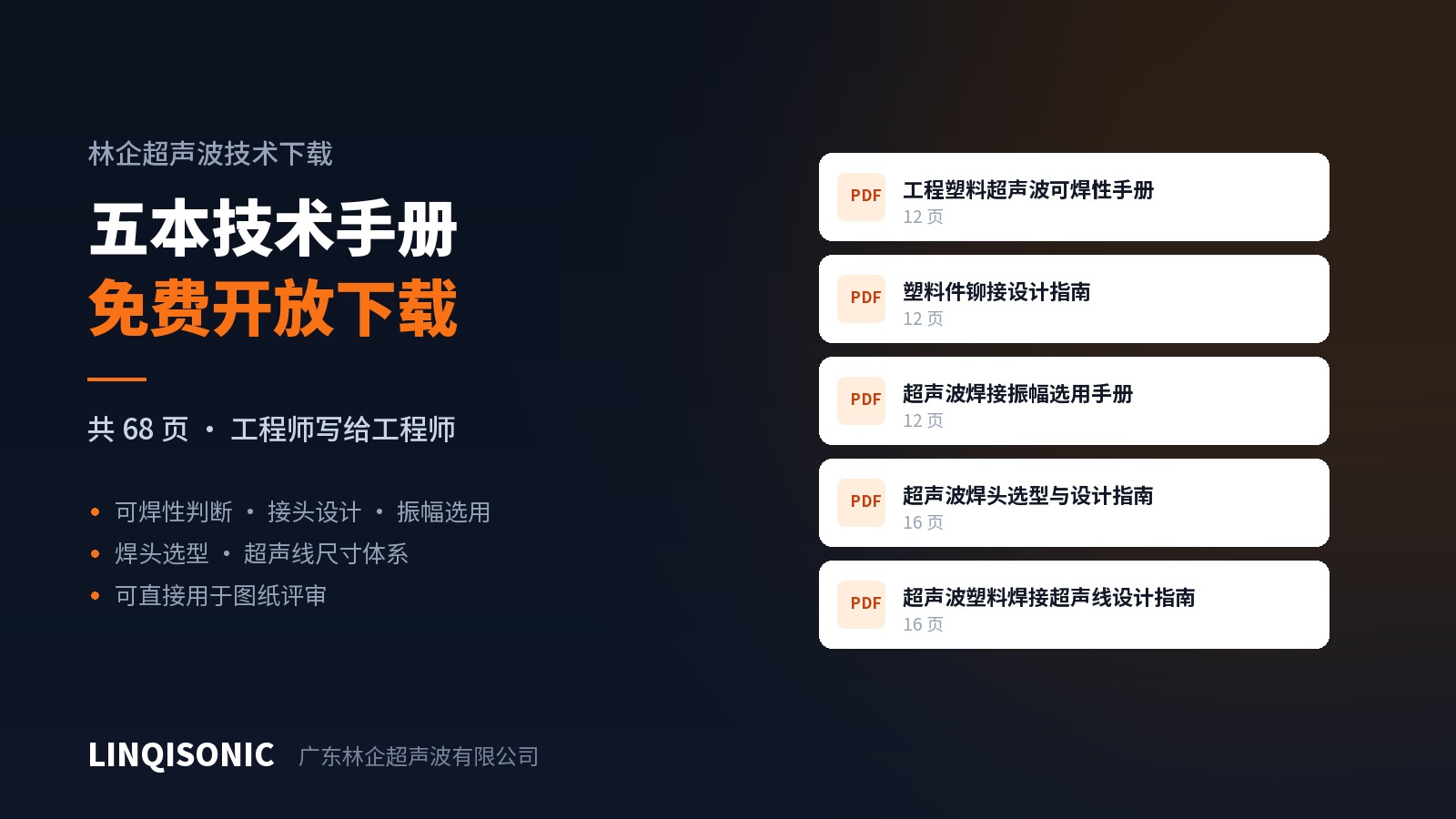
Dongguan, Guangdong — Guangdong Linqi Ultrasonic Co., Ltd. (LINQISONIC) has released five technical handbooks on ultrasonic welding through the downloads section of its website. Running to 68 pages in total, they cover weldability assessment for engineering thermoplastics, staking joint design, amplitude selection, horn selection and energy director dimensioning. The documents are supplied as PDFs.
Why these were written
Most ultrasonic welding problems are created before the equipment ever arrives.
Resin grade, joint geometry and wall thickness are fixed at the drawing stage, and those choices determine whether the part can be welded at all, how much power it will need, and where the yield will settle. By the time the tool is cut and first samples arrive, discovering that the material combination cannot be welded usually means recutting the tool.
Yet there is little reference material available to engineers at the design stage. What most suppliers publish is a product catalogue — an answer to "what equipment do we sell", not to "how should your part be designed". These handbooks address the second question.
What each one answers
Weldability of Engineering Plastics (12 pages)
The first question of all: can this resin be welded. The handbook rates common engineering thermoplastics across five processes — near-field welding, far-field welding, staking, insertion and spot welding — and explains how glass fibre, flame retardants, pigments, regrind and mould release each shift the outcome. It also includes a dissimilar-material compatibility reference: which combinations weld, which are only partially compatible, and which will not join under any conditions.
Plastic Staking Design Guide (12 pages)
There are seven head forms for a staked boss, each with its own boss diameter range, pull-out strength and appearance characteristics. The guide gives the complete dimensional formulas and limits for each, and explains a point that is often missed: why the calculated head volume should come out slightly below the actual volume of the boss, and which form is the exception.
Amplitude Reference Guide (12 pages)
Amplitude is the parameter most often set by feel. The guide explains how requirements differ between material families and why glass-filled grades need more of it — the fibre attenuates the acoustic wave, and at insufficient amplitude the surface overheats before the interface melts. For PC with 30% glass fibre, for example, 70–100μm at 20kHz is the suggested range, noticeably higher than for the unfilled grade.
Horn Selection & Design Guide (16 pages)
The horn is the last stage before the workpiece. The guide covers material choice (titanium, aluminium and steel and where each belongs), the relationship between gain and profile, amplitude uniformity across large horns, and when finite element analysis becomes necessary rather than scaling from experience.
Energy Director & Joint Design Guide (16 pages)
The energy director is the geometric feature that governs weld quality. The guide sets out a complete dimensional system for eight joint types — director height as a proportion of wall thickness, included angle, weld depth, and interference banded by part size — with the reasoning behind each value, plus a design-review checklist and a troubleshooting matrix.
How they were produced
The content draws on the company's accumulated process experience and engineering data. Figures were redrawn in-house, and the dimensional formulas were cross-checked, including by volume conservation. The handbooks contain no model-specific information; they are general design-stage references, independent of whose equipment is used.
They provide a framework for judgement and working ranges — not a substitute for sample trials. Batch variation, pigment loading and tool condition all affect the result, and critical parts should still be trial welded.
Access
All five are available from the downloads page.
The same page also carries application literature for eight industries — automotive, electronics and appliances, new energy, medical, packaging, nonwovens and textiles, household goods and food cutting — each listing typical parts and their quality requirements.
These handbooks discuss design principles and are independent of whose equipment is used. For machines and specifications, see the ultrasonic welding machine pages.
For questions on a specific part, use the online technical consultant on the website, send drawings to 1427498429@qq.com, or call +86 769 8202 9510 / +86 137 6001 0932.