
A Difficult Part Arrives: The Order in Which We Judge Feasibility
A customer brings a part and asks whether it can be welded. Going straight to the machine is the least efficient answer. A fixed order of assessment produces a reliable conclusion in a day or two instead of a month of trials.
Step one: will the materials join at all
If this fails, nothing downstream matters.
Same material is generally fine, but the grade must be confirmed: filler content, impact modifier, flame retardant, pigment and regrind fraction all change the process window. "Both are PP" does not mean they weld; the grades decide.
Dissimilar materials come down to two things: whether the melting points are close, since a large gap means one side melts while the other has not moved, and whether the chemistry is compatible, since only similar polarity allows chain entanglement. Incompatible pairs never weld strongly at any setting, and the right answer there is ultrasonic insertion, staking or mechanical fastening rather than more parameter trials.
Semi-crystalline grades — PA, POM, PP, PE, PPS, LCP — are harder than amorphous ones: a narrow melting range, viscosity changing quickly, higher energy demand, and usually a shear joint with more precise energy control.
Step two: can a joint be designed
Four questions.
Is there a usable joining surface? Enough wall thickness for an energy director or a shear step, enough flange width. A wall that is too thin leaves no room for a joint.
Does it have to seal? Sealed parts essentially require a shear joint, with fit tolerance and flatness demands a grade higher.
Can the flash be managed? Somewhere for a trap, a direction for the flash, and confirmation it will not enter the cavity or the visible area.
Is it stiff enough? Whether the part deflects under weld force, whether the fixture can compensate, whether ribs are needed.
The output of this step is a joint proposal and suggested drawing changes. Without a viable joint there are no parameters to find.
Step three: can the energy reach the joint
Three questions.
Can the horn reach it? Deep cavities, recesses and shadowed joints may be out of reach, and where a long horn is needed, its amplitude and stability have to be assured.
Is there soft material in the path? Overmoulded elastomer, foam or sprung components in the path absorb the energy.
Is there anything vibration-sensitive in the path? Electronics, sensors, diaphragms and thin cantilevers need assessment for damage, addressed where necessary through frequency selection and compliant isolation.
Step four: what are the cosmetic and validation requirements
The first three steps establish that it welds technically; this one decides whether the acceptance criteria are reachable.
Where the visible area is and what marking is permitted. Standards differ greatly between transparent, high-gloss, non-painted metallic and textured parts.
What strength is required and in which direction. Tension, shear, peel, impact and fatigue make entirely different demands.
The sealing requirement and its test method. The permitted leak rate, and how every part will be tested.
Whether it must survive ageing. Thermal cycling, vibration, media, damp heat.
Only then, samples
After those four steps, what remains is worth taking to the machine. Sampling should do more than produce one presentable part: it should establish the process window — where the upper and lower energy limits lie, what defect appears beyond each, and how much variation still passes.
A wide window means stable production; a narrow one produces problems in volume however good the samples looked. A sampling report should state the width of the window, not only one set of parameters.
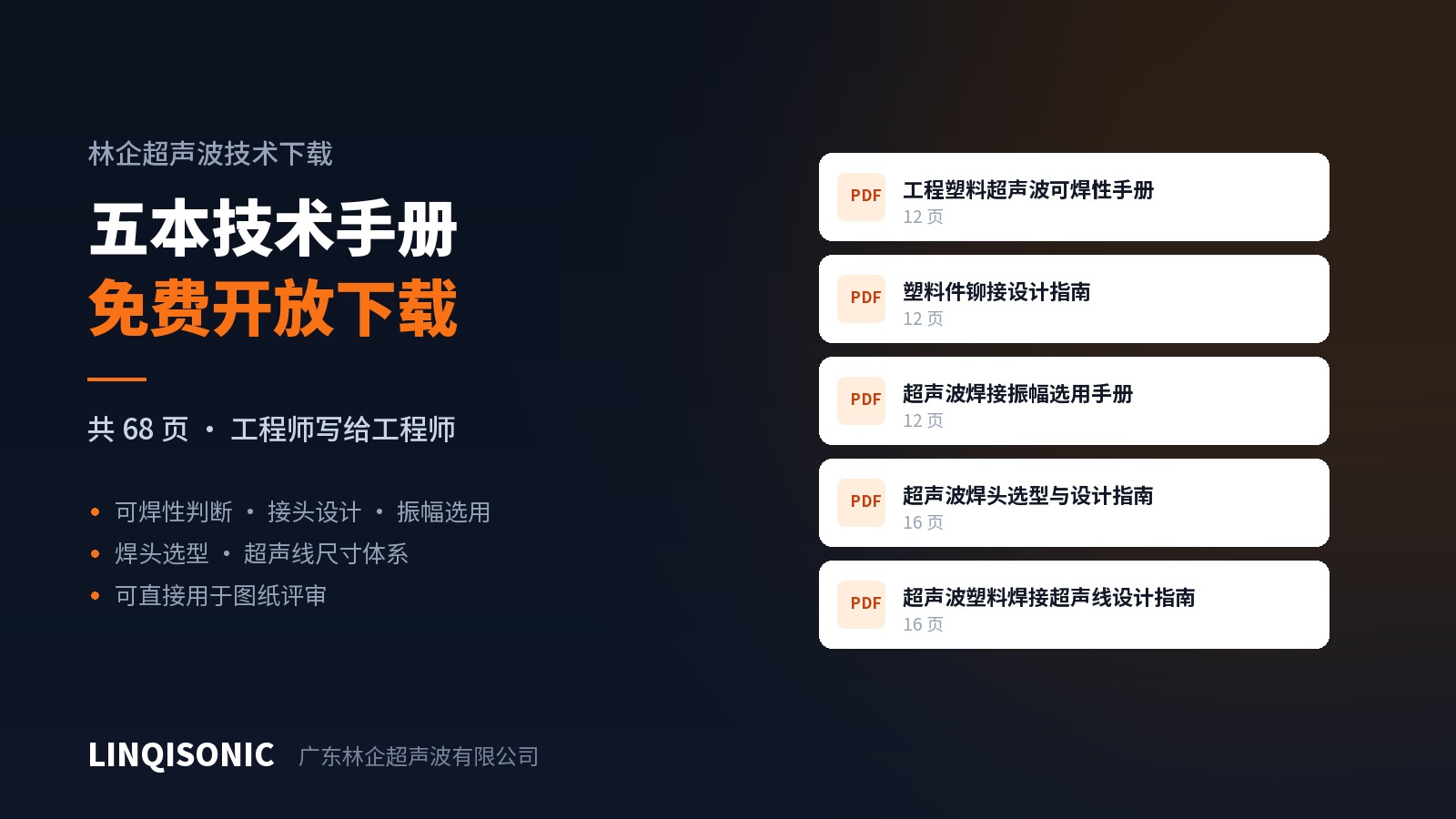
Material compatibility, joint design and window determination are in the handbooks on the downloads page. Machines from 15kHz to 40kHz with energy and depth modes are on the ultrasonic welding machine pages.
Send drawings, grades and validation requirements to 1427498429@qq.com, or call +86 769 8202 9510 / +86 137 6001 0932.