
Ultrasonic, Resistance or Laser: Choosing a Metal Joining Method
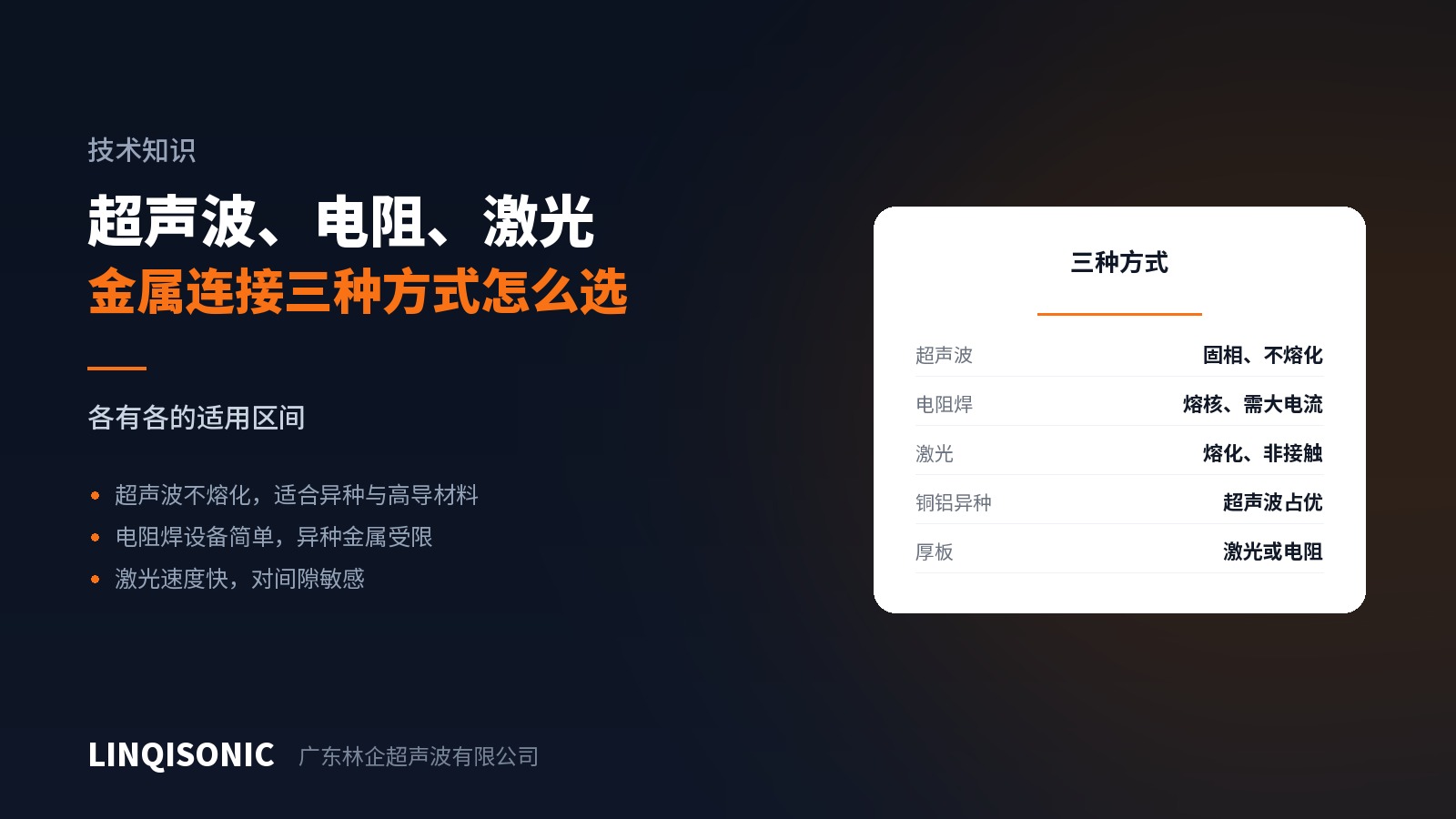
For battery, motor and electronic connections, metal joining usually comes down to these three. They are not substitutes for one another; each has its range.
Ultrasonic welding
Principle: nothing melts. Lateral shear breaks up the oxide so fresh metal atoms make direct contact in a solid-state bond.
Strengths:
Highly conductive metals such as copper and aluminium, where fusion methods lose heat too fast and a process that does not rely on heat has the advantage;
dissimilar metals, copper to aluminium above all, since without melting no brittle intermetallic forms;
multiple thin layers — battery tabs and foil stacks;
heat-sensitive assemblies — a small heat-affected zone leaves nearby insulation and components intact.
Limits: not for thick sections; the work must be clampable and supportable; joints are limited to lap configurations.
Resistance welding
Principle: heavy current through the contact area melts a nugget by contact resistance.
Strengths: spot welding steel, with mature equipment, low cost and fast cycles — the basis of automotive body assembly for decades.
Limits: difficult on highly conductive materials like copper and aluminium, where low resistance means heat does not build without extreme current; restricted dissimilar combinations; spatter and electrode wear; a larger heat-affected zone.
Laser welding
Principle: a high-energy beam melts locally.
Strengths: fast, non-contact, able to reach positions that are hard to clamp, high depth-to-width ratio, well suited to automation.
Limits: very sensitive to fit-up gaps, which prevent welding when they open; copper absorbs common wavelengths poorly and needs a dedicated approach; high capital cost; intermetallics remain an issue for dissimilar metals; a heat-affected zone exists.
By application
Battery tabs, multi-layer aluminium or copper foil — ultrasonic dominates; multiple layers and high conductivity are exactly its strengths.
Copper-to-aluminium transitions — a clear advantage for ultrasonic, since not melting avoids intermetallics.
Harness terminations — ultrasonic harness welding is a mature application with lower and more stable contact resistance than crimping.
Steel structural spot welds — resistance welding, on cost and cycle time.
Motor stator joints and sealed seams — laser, where continuous seams and penetration are required.
Thick structural sections — beyond ultrasonic; consider fusion processes.
Three questions first
1. What is the material combination? Copper, aluminium or dissimilar metals point to ultrasonic.
2. What thickness and section? Thin, multi-layer work is ultrasonic territory; thick sections move to fusion.
3. Is anything nearby heat-sensitive? With insulation, electronics or seals close by, a small heat-affected zone is a real advantage.
Answering those three usually leaves one or two candidates.
Power, frequency and material suitability for metal welding machines are on the ultrasonic welding machine pages. Send material combination, thickness and joint form to 1427498429@qq.com, or call +86 769 8202 9510 / +86 137 6001 0932.