
Ultrasonic Insertion and Staking: Joining Without Compatibility
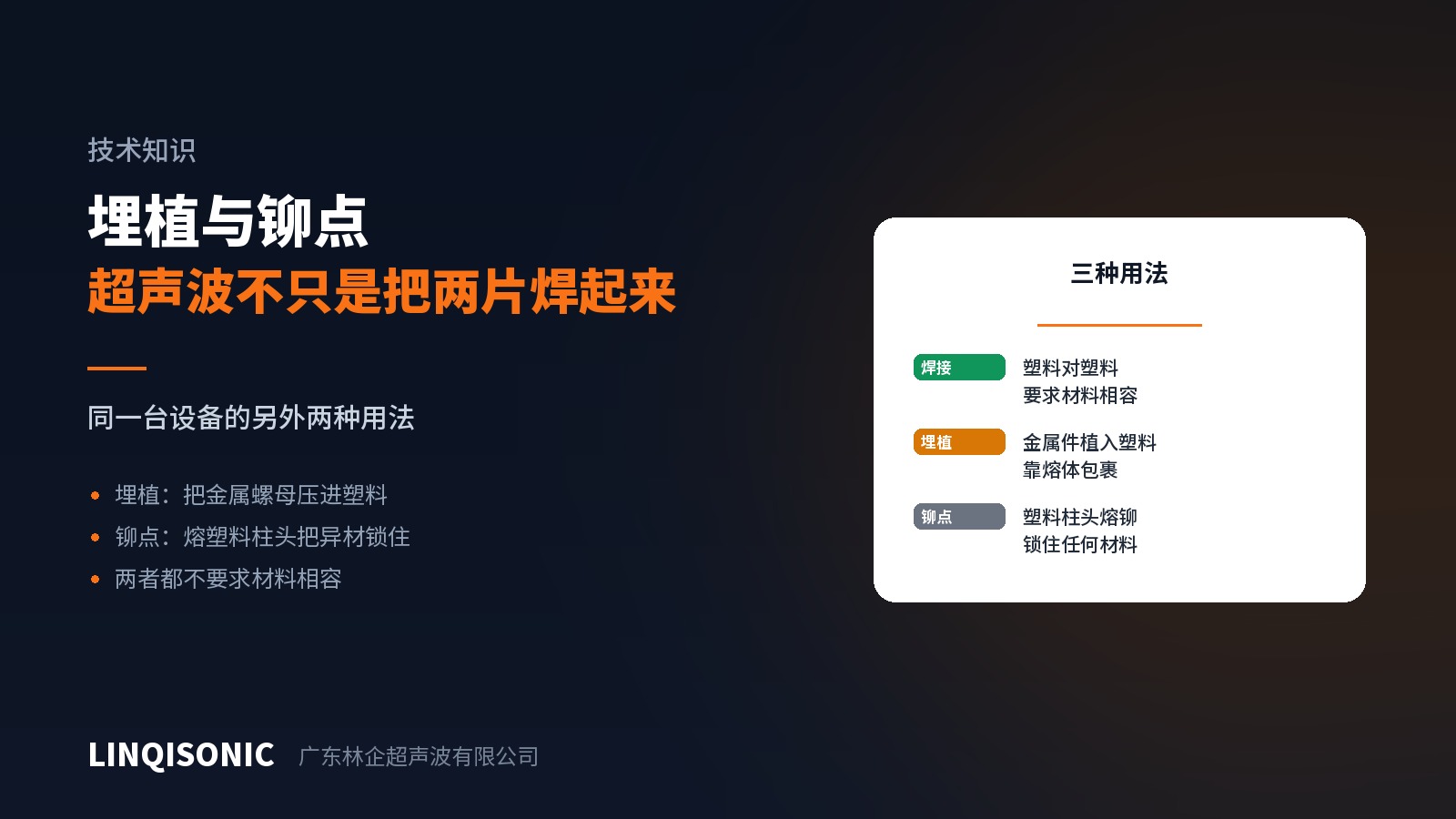
Ultrasonic equipment is often assumed to do only plastic-to-plastic welding. With different tooling, the same machine performs two further operations — and neither requires material compatibility.
Insertion: pressing metal inserts into plastic
What it does: where a plastic part needs a metal thread, moulding the insert in is costly and inflexible. Insertion leaves a slightly undersized hole in the moulding and presses a knurled metal insert in ultrasonically afterwards.
Principle: the insert vibrating against the hole wall generates friction heat, the plastic melts locally, and force drives the insert home; molten plastic flows into the knurl and undercuts on the insert and locks it in place on cooling.
Advantages: no mould change, the option to add or replace inserts later, far higher pull-out and torque strength than self-tapping screws, and a shorter cycle than thermal pressing.
Key points:
Control the hole tolerance. Too large and the plastic cannot fill the knurl, so nothing locks; too small and excess plastic is displaced onto the surface, possibly splitting the boss.
Provide enough depth and wall thickness. A thin boss wall splitting is the commonest insertion failure.
Knurl direction sets the load direction. Pull-out and torque resistance need different knurl forms; choose by the load in service.
Use distance mode to control depth. The critical result is the insert face height relative to the plastic surface, which distance mode addresses directly.
Staking: melting a boss to capture a part
What it does: a boss on the plastic part passes through a hole in another component, and ultrasound melts the boss head into a mushroom rivet that captures it.
The captured part can be any material — sheet metal, a PCB, an incompatible plastic, a trim piece, glass — because it takes no part in fusion and is simply held. This is staking's greatest value: a route for combinations that cannot be welded.
Key points:
Match boss volume to head form. Plastic is conserved: boss height and diameter determine the head that can form. Too short and the head does not fill the hole; too tall and material spreads beyond it. Calculating this at the design stage beats adjusting parameters on the machine.
Leave clearance between boss and hole. An interference fit prevents full engagement or splits the hole on assembly.
Support the captured part. Unsupported items such as PCBs bow under staking force.
Control energy. Excess energy collapses the whole boss, leaving a head too thin to hold.
Use distance or energy mode, since head height is the critical dimension.
Choosing between them
A removable threaded connection → insertion.
Permanent fixing with no need to dismantle → staking, at lower cost.
Compatible materials requiring a seal → welding.
Incompatible materials with no seal requirement → staking.
Incompatible materials that also need a seal → stake for fixing and add a gasket for sealing, solving the two requirements separately.
One thing in common
Insertion and staking use the same generator and acoustic system as welding, differing only in tooling and parameters. On a line that already has ultrasonic welding, adding either costs very little at the margin — worth remembering during process planning.
Distance mode options and tooling capability are on the ultrasonic welding machine pages. Send drawings with insert specifications or boss dimensions to 1427498429@qq.com, or call +86 769 8202 9510 / +86 137 6001 0932.