
Ultrasonic Welding of Busbars and Large Conductors
Busbar connections and heavy cable terminations in electric vehicles and energy storage have clear advantages under ultrasonic welding: no melting of the parent metal, no filler, low contact resistance and a small heat-affected zone.
But the demands on equipment are an order above ordinary harness work.
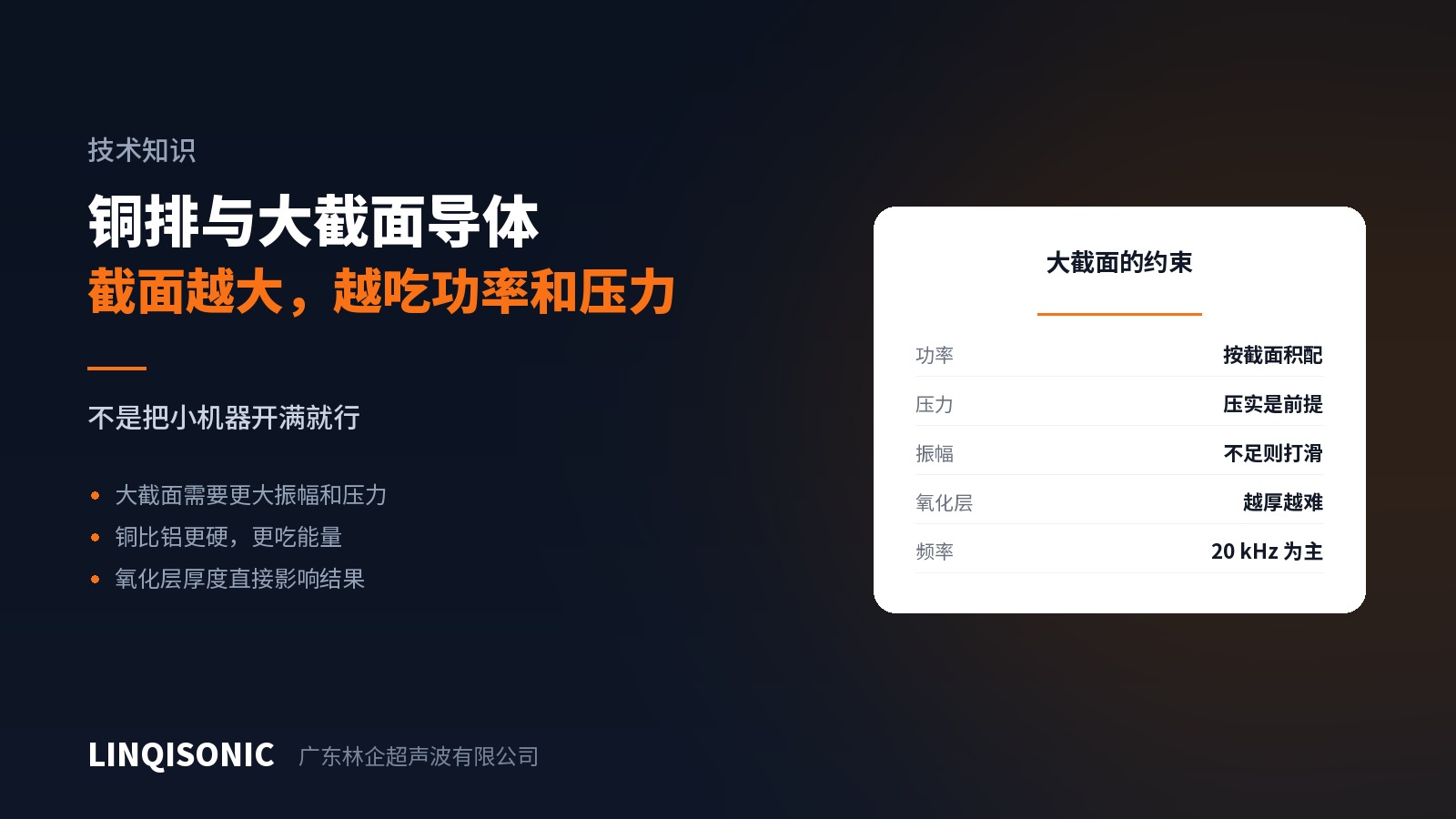
Section area sets the power
Metal ultrasonic welding must produce enough shear across the whole contact area to break up the oxide. Double the area and the energy required rises with it.
A common mistake is taking a small harness machine to a busbar and running everything at maximum. The result is energy that will not go in, a slipping horn, bright wear on the surface, and a joint that opens by hand. That is not a parameter problem but a capability shortfall.
Large sections require power selected from the section area — a calculation that belongs at the selection stage.
Force must follow
A large contact area needs proportionally more total force to reach the same contact pressure. Where force is short, some regions consolidate and others do not, the bond region becomes patchy, and both resistance and strength wander.
Once force rises, frame stiffness becomes the constraint in turn: a head that deflects under load cannot hold horn-to-work parallelism. On heavy-section machines the frame has to be more than solid-looking.
Copper versus aluminium
Copper — harder and more thermally conductive, needing greater amplitude and force to initiate bonding, with a relatively dense oxide.
Aluminium — soft and readily deformed, with gentler parameters than copper. Its oxide, however, is very stable and forms fast: a freshly cleaned aluminium surface re-oxidises within minutes. Fortunately breaking up oxide is exactly what the process does, which makes aluminium easier to weld ultrasonically than by fusion.
Copper to aluminium — ultrasonic welding is one of the few workable methods for this pairing, precisely because nothing melts and no brittle intermetallic forms. Parameters lie in the overlap of the two windows, usually narrower than for like-to-like.
Oxide and surface condition
Oxide thickness directly affects the energy required. Within one batch, different storage times and environments give different oxide states and correspondingly variable results.
In practice, controlling how long and where incoming parts sit beats adjusting parameters afterwards. Oil, coatings or plating on the surface must be declared during process planning, since plating changes the behaviour markedly.
Verification
Contact resistance. The critical indicator in high-current applications, and applicable to every part.
Pull and shear. Load in the direction the joint actually sees.
Metallographic sections. Check bond continuity and the absence of cracks and voids, periodically.
Temperature rise. Run rated current and measure the joint's rise — the verification closest to service.
Frequency
Heavy conductors run mainly at 20 kHz, where higher available power and a larger area ceiling match the requirement. 30 to 40 kHz suits small sections and precision work.
Power ratings, force ranges and frame considerations by model are on the ultrasonic welding machine pages. Send material, section area, layer count and joint form to 1427498429@qq.com, or call +86 769 8202 9510 / +86 137 6001 0932.