
Crimp or Weld? What Changes at the Terminal Interface
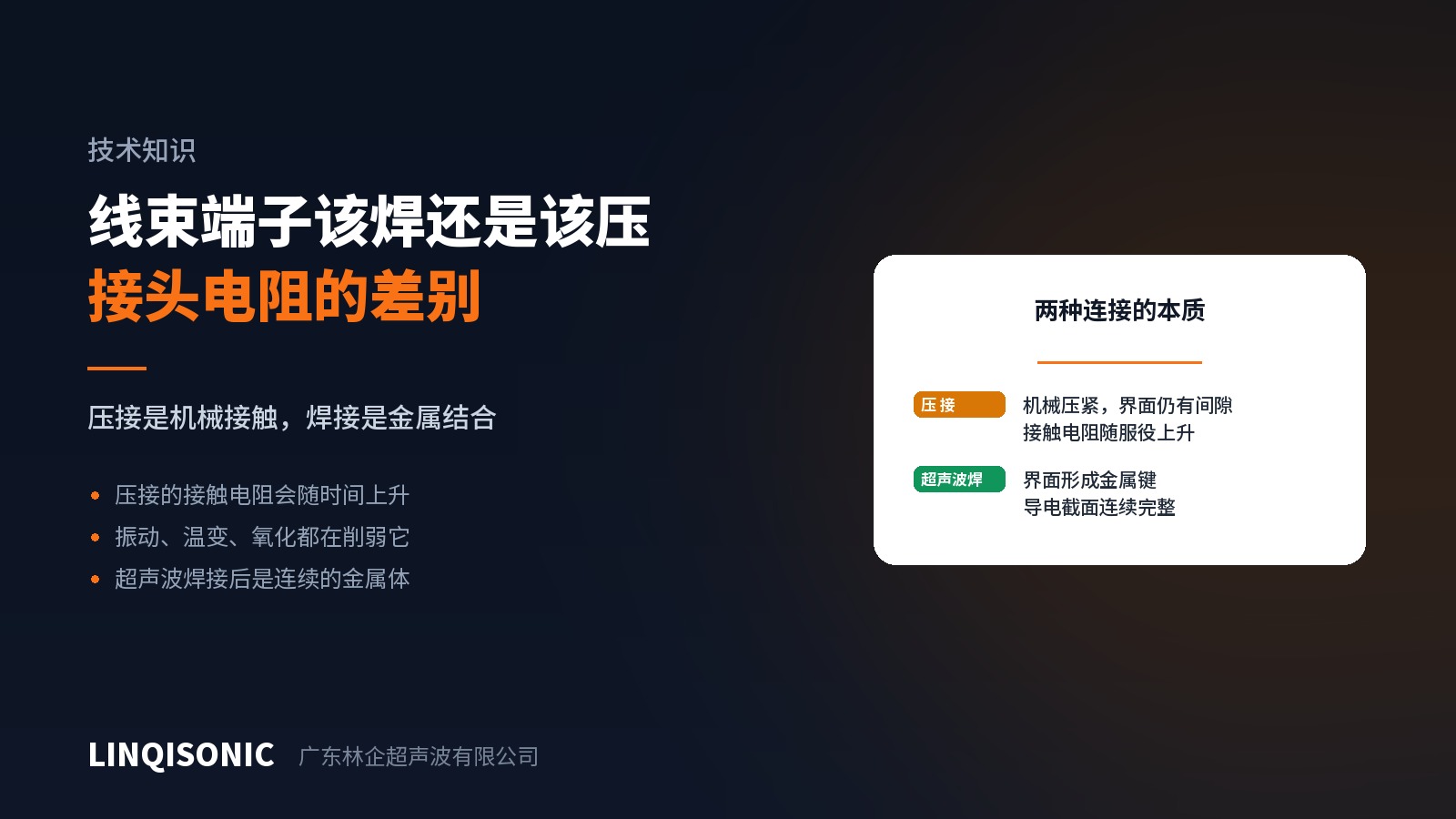
Crimping has served wire harness terminations for decades: proven, fast and cheap. So why do more and more applications move to ultrasonic welding?
The difference is not about initial strength. It is about how the joint behaves electrically over time.
What a crimp is
Crimping deforms terminal and conductor together mechanically, and contact is maintained by elastic recovery and friction. It is mechanical contact, not a metallurgical bond.
That means microscopic gaps remain at the interface. A fresh crimp can have very low resistance, because contact force and the number of contact points are both adequate. Once in service, however:
- vibration causes fretting between contact points, and oxide accumulates in the gaps;
- thermal cycling expands and contracts copper and terminal material at different rates, gradually relaxing the contact force;
- oxidation and galvanic corrosion continue within the gaps, particularly between copper and aluminium.
Together these raise contact resistance slowly. Higher resistance causes local heating, which accelerates oxidation and stress relaxation — a self-reinforcing loop. Crimped joints typically fail not by sudden disconnection but by long, gradual degradation.
What ultrasonic welding changes
Ultrasonic metal welding disperses the surface oxide so clean metal forms metallic bonds under force. The interface is no longer two pieces of metal held together — it is one continuous piece of metal.
With no gaps there is no gap oxidation and no fretting; with no elastically maintained contact force there is no stress relaxation. Joint resistance starts low and stays stable.
Ultrasonic welding also needs no solder or flux. Crimping needs none either, but some processes add solder afterwards — which makes the joint hard and brittle and, under vibration, creates a crack initiation site.
Where the change is worth making
Vibration. Automotive, rail and construction equipment — wherever the joint sees sustained vibration, crimp degradation accelerates.
High current. The larger the current, the more heat contact resistance produces, and the higher the demand on joint stability. Traction batteries and charging infrastructure are obvious cases.
Copper to aluminium. Galvanic corrosion within the crimp gaps makes this one of the hardest conditions for crimping to handle.
Traceability requirements. Crimp quality is judged mainly by crimp height and sample pull testing, which yields limited process data. Ultrasonic welding can set limits on energy, power, force and post-weld height for every cycle and record them part by part.
Not every case should change
Crimping has real advantages: low equipment cost, fast cycle, highly standardised terminals and easy field work. For small cross-sections, low current and non-vibrating environments, crimping remains the sensible choice.
The real test is this: will this joint's resistance stay stable across its whole service life? Where the answer is in doubt, the process is worth revisiting.
Our harness welding equipment covers copper harnesses and terminals across a range of cross-sections; see the ultrasonic welding machine pages.
Send cross-section, material and joint configuration to 1427498429@qq.com, or call +86 769 8202 9510 / +86 137 6001 0932.