
Welding Clear Parts: Visibility and Strength at Once
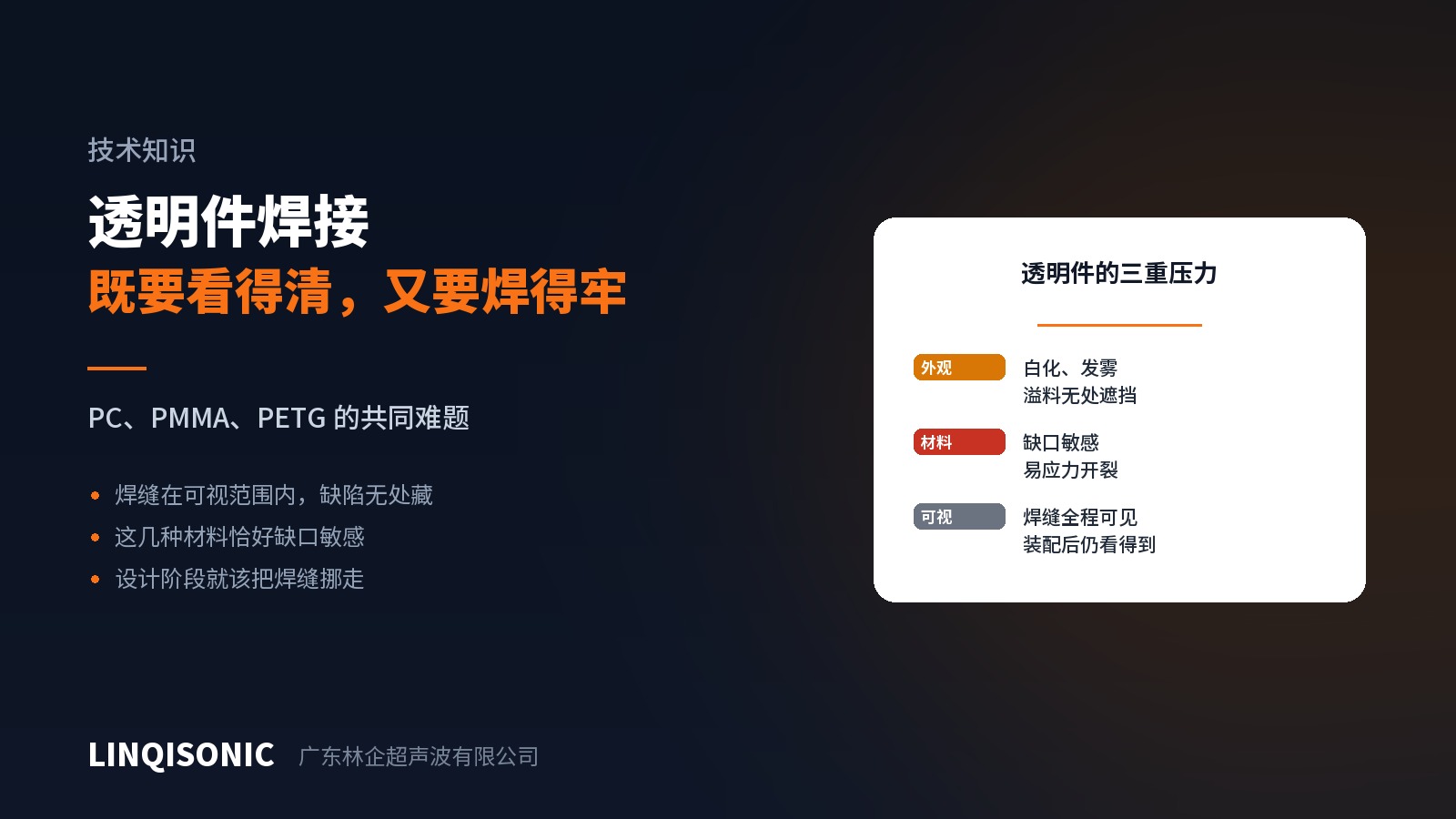
Welding clear parts is a combined examination: the joint cannot be hidden, the material is delicate, and every defect is on display.
Three pressures
The joint is fully visible. On opaque parts the joint disappears after assembly; on clear parts it is visible right through, and whitening, haze, flash or bubbles have nowhere to hide.
The material is notch-sensitive. Both PC and PMMA respond badly to stress concentration. The edge of a horn impression, a sharp corner on the joint, or a fixture contact point can all become concentration sites leading to whitening or cracking. PMMA is the more brittle of the two.
Appearance standards are higher. Tolerance for cosmetic defects on clear parts is low to begin with. The same slight haze passes unnoticed on black ABS and rejects the part in clear PC.
What design can do — the most effective route
Move the joint out of sight. The most effective measure and the only real cure. Faces concealed after assembly — side walls, undersides, beneath flanges — are all worth considering. Ten minutes on the drawing beats three months of parameter work.
Design a flash trap. Flash is conspicuous on clear parts; a groove beside the joint lets melt flow inward rather than out.
Avoid sharp corners. Radius the transitions on the joint to reduce stress concentration, lowering the risk of both whitening and cracking.
Consider the joint form. A shear joint contains melt between the mating faces and usually looks cleaner than an energy director — but it needs stiff side walls, and the thin-walled boxes common in clear parts need checking.
What process can do
Enlarge horn contact area and reduce pressure. Marking shows far more on clear parts; more area and less force means lighter marking.
Polish the horn face. Any texture on the working face transfers one-to-one onto a clear surface. A polished horn is close to mandatory here.
Slow the approach. Impact at contact is a major source of both marking and stress whitening.
Extend hold. Letting the melt solidify slowly under force reduces internal stress and the whitening that emerges later.
Err slightly low on energy. Evidence of overheating — yellowing, bubbles — is harder to explain than a weak joint. But not so low as to cold weld: appearance and fusion must be confirmed separately.
Material notes
PC, PMMA and PETG are all amorphous and weld reasonably well. The challenge lies in appearance and notch sensitivity, not in weldability.
PMMA is fully compatible with ABS, a pairing widely used where a transparent window is required; PC and ABS are only partially compatible, with a narrower window that needs more care. The full compatibility reference is in the Weldability of Engineering Plastics handbook on the downloads page.
Force control and approach speed by machine are on the ultrasonic welding machine pages. Send part drawings and appearance requirements to 1427498429@qq.com, or call +86 769 8202 9510 / +86 137 6001 0932.