
Welding POM: Slippery, Stiff and a Narrow Melting Range
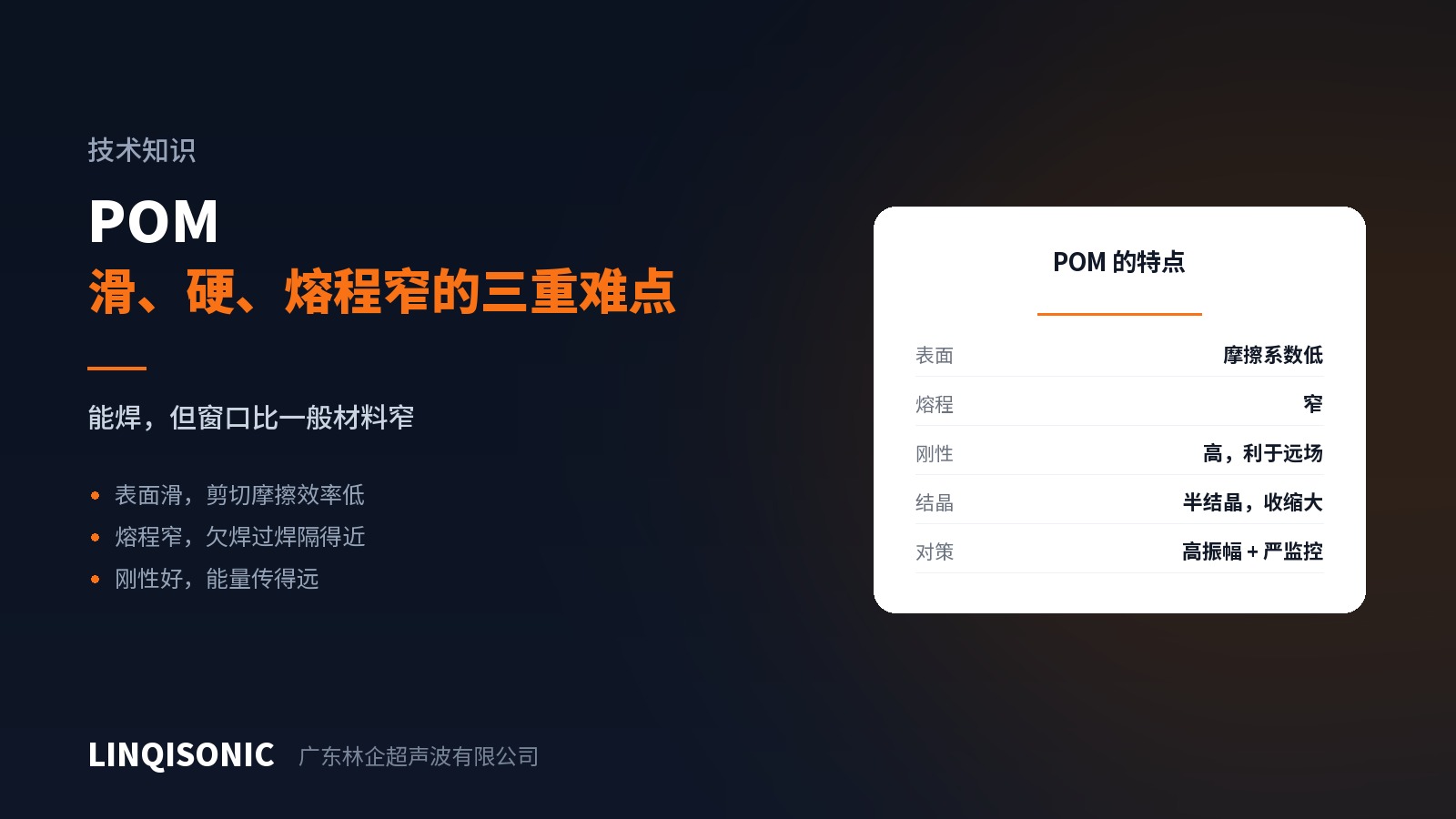
POM welds, but three of its characteristics make the process window narrower than usual. Knowing which three gives set-up a direction.
1. A slippery surface
Self-lubrication is what POM is bought for — gears and slides use it precisely for that. For ultrasonic welding, however, a low friction coefficient means interfacial friction generates heat inefficiently.
The start-up phase relies on that friction to raise temperature, and POM is slower here than materials such as ABS. The remedy is higher amplitude, using greater relative displacement to compensate.
2. A narrow melting range
POM is highly crystalline, with a narrow interval between solid and molten. That leaves little margin between under- and over-welding — slightly too little energy and nothing fuses, slightly too much and it decomposes.
Decomposing POM releases an irritant gas, which is unmistakable on the floor: a sharp smell means excess energy and calls for an immediate reduction. Extraction at the station is essential.
Control energy tightly: use energy or distance mode, not time mode. Time mode cannot compensate for incoming variation, and the POM window will not absorb it.
3. Stiff, so energy travels
This one is an advantage. POM is stiff and acoustically efficient, so far-field welding is easier than with most materials and the horn can contact well away from the joint.
It also means vibration reaches other features. Where the part carries thin cantilevers or precision structures, watch for resonance damage.
Joint design
Give the energy director enough height. Because start-up is slow, the director must provide sufficiently concentrated initial contact; a short director makes POM particularly prone to cold welds.
Prefer a shear joint. POM shrinks considerably, and a shear joint tolerates dimensional variation better than a butt joint — especially for sealed parts. It also keeps the melt confined between the mating faces and away from air, reducing oxidative decomposition.
Provide a flash trap. POM melt flows readily and flash is conspicuous; a groove routes it out of sight.
Parameter direction
Amplitude on the high side — compensating for slow friction start-up.
Force moderate to low — excessive force squeezes an incompletely fused interface apart.
Time as short as possible — with a narrow window, a long cycle is a gamble.
Adequate hold — POM shrinks a lot, and insufficient hold leaves voids and residual stress.
Energy or distance mode — more important for POM than for most materials.
On dissimilar materials
POM essentially welds only to POM. It is incompatible with the other common engineering plastics and ultrasonic welding will not join them. Where the design requires POM against another material, use a mechanical fastening or an adhesive.
The full compatibility reference is in the Weldability of Engineering Plastics handbook on the downloads page. Amplitude ranges and mode options are on the ultrasonic welding machine pages. Send drawings and grade to 1427498429@qq.com, or call +86 769 8202 9510 / +86 137 6001 0932.