
Ultrasonic Tube Sealing: Closing a Copper Tube Without a Flame
Charging ports on refrigeration circuits, accumulator closures, heat-pipe end seals — work traditionally done by flame brazing. Ultrasonic tube sealing offers another route.
How the seal forms
The tube is clamped between horn and anvil. Force brings the two tube walls together, then high-frequency vibration disperses the oxide on the contact faces so the metal on each side bonds directly into one piece. Sealing and cut-off happen in the same action — the clamped zone forms the seal while the surplus length outside it is severed.
The base metal never melts. This is a solid-state cold weld.
Compared with flame brazing
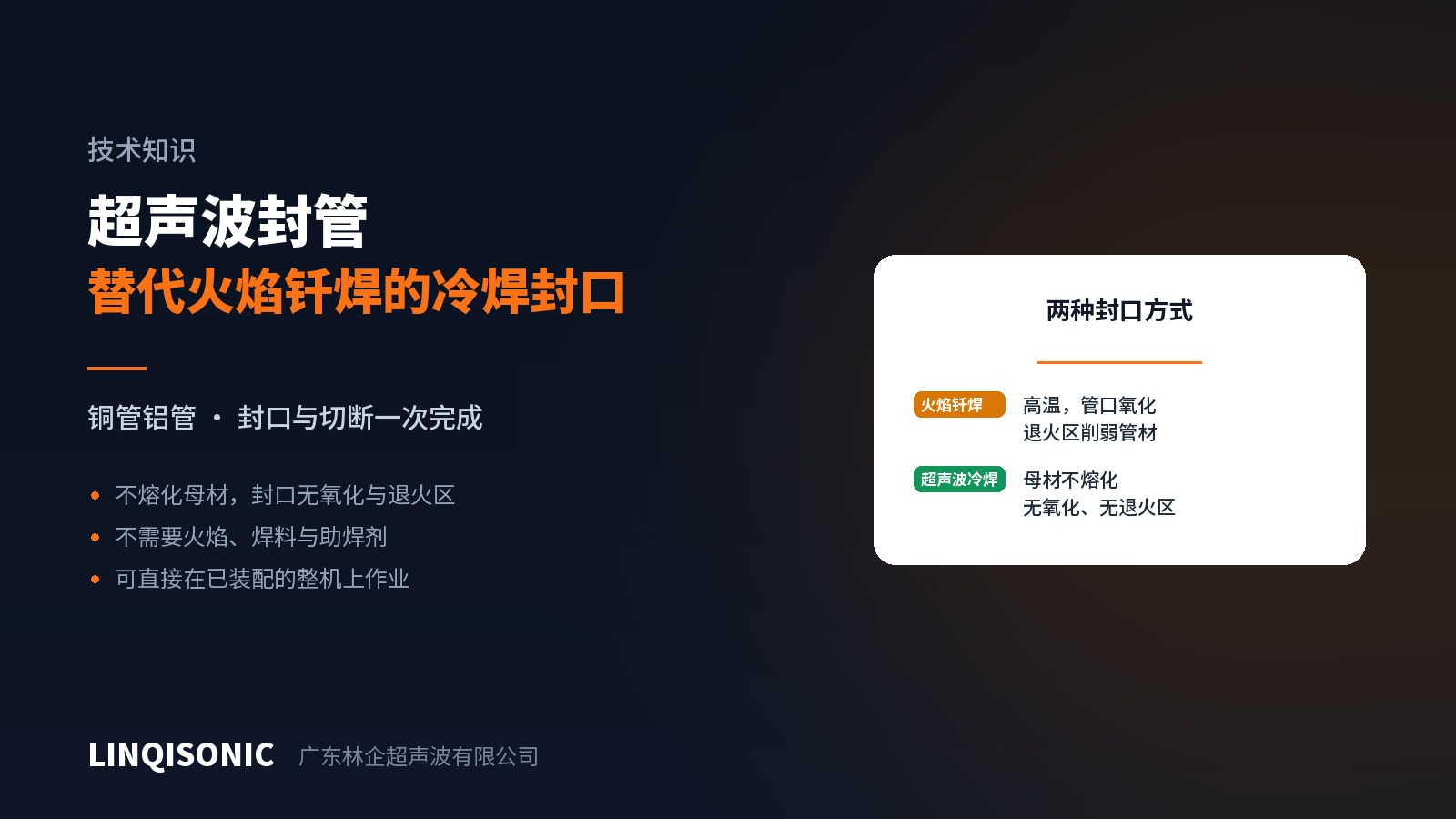
No oxidation, no annealed zone. Brazing heats the tube end to the filler's melting temperature, so the tube itself sees high temperature and an annealed, softened ring forms around the seal, reducing hardness and pressure capability. Inner and outer walls also oxidise, and scale can detach into the system. A cold weld runs far below melting temperature and has neither problem.
No consumables. No filler, no flux, no gas bottle. Flux residue inside a refrigeration system is a long-term liability; a cold weld removes it at source.
No open flame. Working with a flame beside an assembled unit — particularly one already charged with refrigerant — carries risk. A cold weld does not, and can be applied on the line or on the finished unit.
A controllable process. Braze quality depends heavily on operator feel: heat, timing and filler feed. A cold weld is governed by machine-controlled energy and force, which makes consistency easier to hold.
What it can seal
Soft non-ferrous tube — copper and aluminium — matching the general envelope of ultrasonic solid-state joining: soft, conductive, with wall thickness in a sensible range.
Our G20 handheld tube sealer separates the generator from the handheld head, leaving only a grip and start button at the working end, so it can be used on the line or on an assembled unit. See the ultrasonic welding machine pages.
Points to watch
Tube-end condition affects the result. Burrs, ovality or oil residue on the inner wall interfere with wall-to-wall contact and therefore with the seal. Incoming tube-end quality deserves a specification.
Verify the seal level by test. Leak tightness depends on tube material, wall thickness, tooling design and parameters together. Any general figure from a supplier is indicative only; for your tube and your duty it has to be trialled and verified against your own leak criteria.
Send tube material, outside diameter, wall thickness and sealing requirement to 1427498429@qq.com, or call +86 769 8202 9510 / +86 137 6001 0932.