
PEI and PSU/PPSU: Welding Transparent High-Temperature Resins
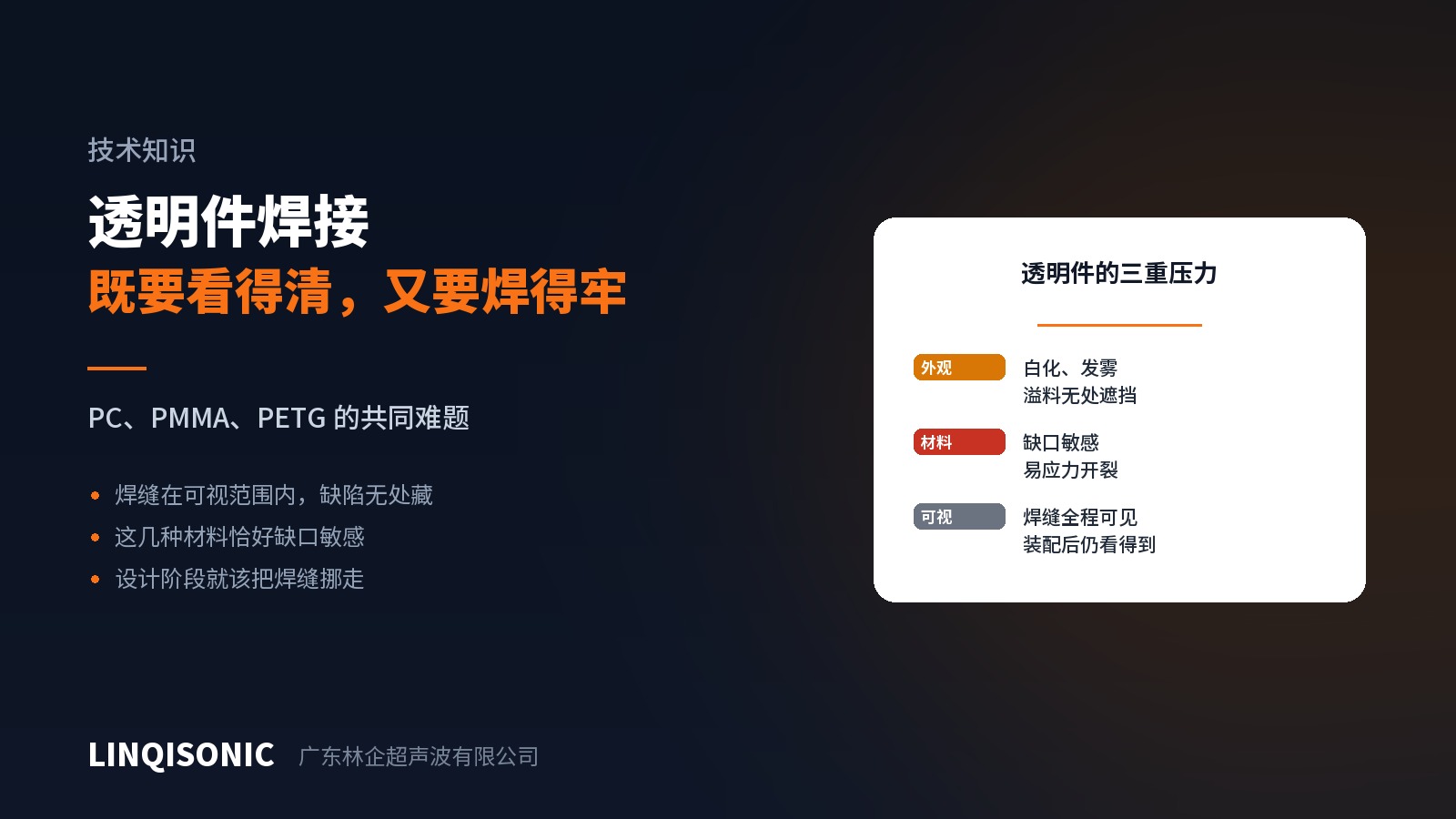
PEI, PSU and PPSU appear in medical devices, laboratory ware, aircraft interiors and electronics, chosen for heat resistance, repeated sterilisation and transparency or translucency.
The good news: they are amorphous
Unlike semi-crystalline high-temperature resins such as PEEK and PPS, PEI and the sulfones are amorphous, with no sharp melting point and a relatively broad softening range. Mechanically they are easier to fuse than PEEK, and the window is not extreme.
The threshold is high, though: glass transition sits around two hundred degrees, so bringing the interface to a flowable state needs far more energy density than ABS or PC. Amplitude is the first variable, not the last.
The difficulty is elsewhere
Notch sensitivity. These resins are reasonably tough but still sensitive to stress concentration, PEI especially. Avoid sharp corners on the joint, hard locating points in the fixture and excessive interference. Radius, pad and take interference at the low end, all three.
Appearance on transparent parts. Transparency means the joint cannot be hidden, and whitening, haze and bubbles are all visible. The horn face must be polished, contact points should sit on non-visible faces, and flash needs a trap.
Residual stress plus chemical contact. In medical use these parts meet disinfectants and cleaners; in laboratory use they meet solvents. Residual weld stress plus chemical contact is the classic recipe for environmental stress cracking. Lower the weld force and extend hold to reduce stress, and confirm the chemicals in contact are compatible.
It has to survive sterilisation
This requirement is specific to these materials and the most easily missed. Validation cannot stop at strength immediately after welding; it has to cover strength after sterilisation.
Repeated autoclave cycles, gamma irradiation and ethylene oxide each affect the material differently: irradiation embrittles some resins, steam cycling is repeated thermal stress, and ethylene oxide raises residue questions. The material state at the weld differs from the bulk, and the weld is usually where failure begins.
A validation plan should therefore include strength immediately after welding, strength after the specified number of sterilisation cycles, and leak testing of sealed parts after sterilisation.
In short
Give it amplitude; use energy or depth mode rather than time; prefer a shear joint with interference at the low end and radiused corners; polish the horn and keep contact off visible faces; extend hold to reduce residual stress; and use soft contact in the fixture so hard points do not press in micro-cracks.
These resins are not cheap, so budget for trial parts. Parameters have to come from trials, because geometry, wall thickness and optical requirements all move the result.
One caution
Treat any offer of "general high-temperature welding parameters" with suspicion. The real values depend on grade, wall thickness, joint form and fixture condition and can only be established by trial. Trial first, fix the parameters, then lock them in with process monitoring is the only dependable route.
Difficulty ratings, the compatibility matrix and notch sensitivity are on the downloads page. Amplitude ranges, hold control and multi-dimensional monitoring are on the ultrasonic welding machine pages.
Send the grade, sterilisation method and drawings to 1427498429@qq.com, or call +86 769 8202 9510 / +86 137 6001 0932.