
Can Fluoropolymers Be Ultrasonically Welded
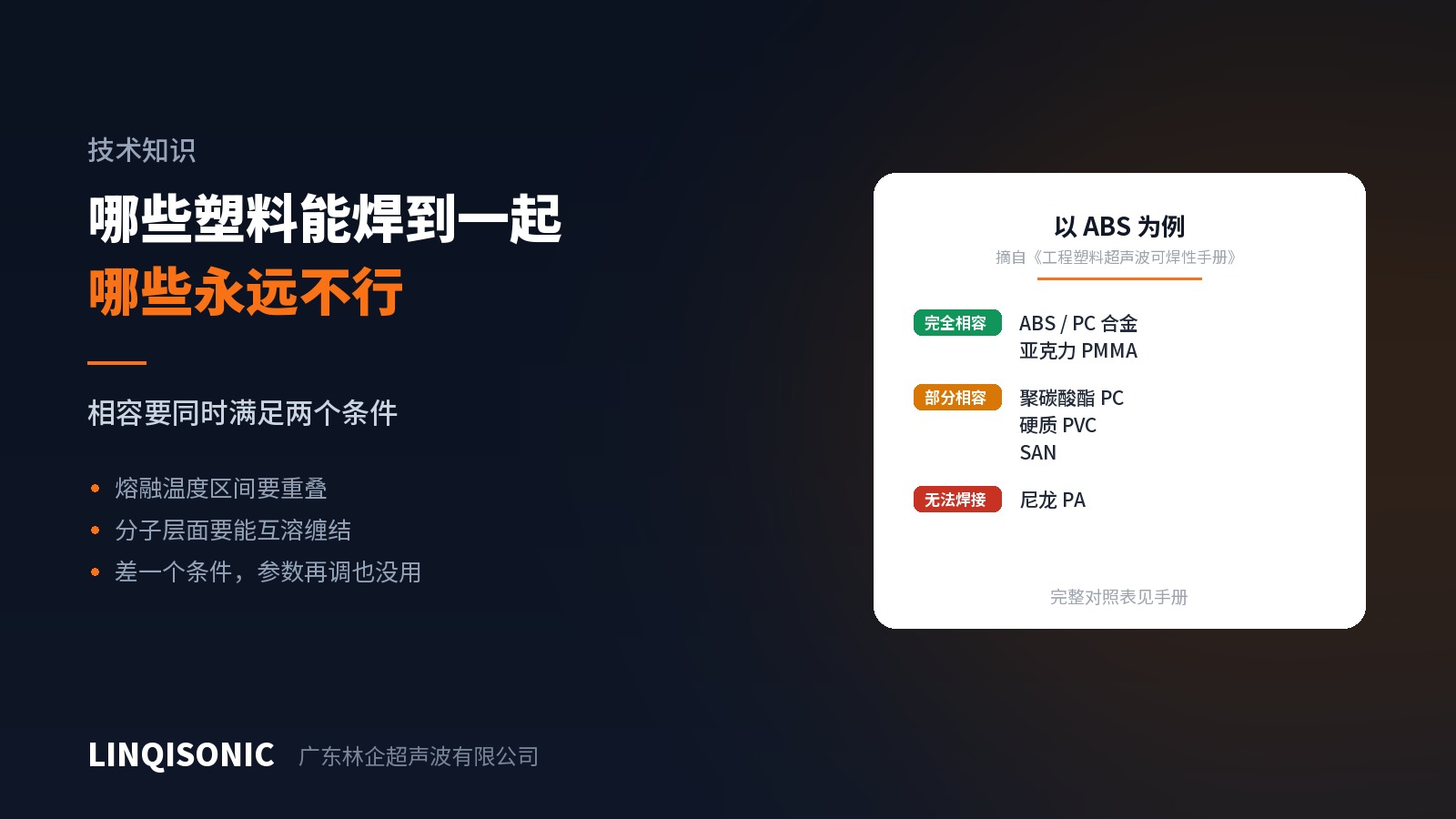
The question comes up often, and the answer has to be split, because "fluoropolymer" is not one material.
PTFE: no
The conclusion first. PTFE cannot be ultrasonically welded, for reasons rooted in the material.
It does not truly melt and flow. Above its melting point PTFE becomes an extremely high-viscosity gel rather than flowing and filling like a conventional thermoplastic. Ultrasonic welding depends on melt flow plus molecular diffusion, and that link is missing.
Very low surface energy. Non-stick is the selling point, and molecules at the interface do not readily bond.
High damping and poor transmission. The wave attenuates quickly inside it.
So with a PTFE part, do not spend time on parameters. Change the joining method: mechanical clamping with a seal, a bolted flange, a dedicated hot-melt bonding process, or a structure that avoids joining PTFE at all.
PFA and FEP: melt-processable, still difficult
These are melt-processable fluoropolymers, so in principle melt flow exists and there is more hope than with PTFE. The difficulties remain: high melting point, high melt viscosity, low surface energy and poor transmission.
If it must be attempted, the direction is near-field design, high amplitude, a shear joint, a rigid fixture, energy or depth mode and a long hold — while accepting that joint strength will fall far below parent material.
In practice such parts more often use hot-plate welding, flanges or mechanical seals; ultrasonic is not the mainstream choice. If a supplier insists fluoropolymer ultrasonic welding is no problem, ask a few more questions.
PVDF: relatively workable
PVDF is the easy one among fluoropolymers. It is semi-crystalline with a defined melting point and genuine melt flow, and ultrasonic welding is feasible.
Treat it like other semi-crystalline resins: prefer a shear joint, give it amplitude, use energy or depth mode, hold promptly and keep the fixture rigid. The window is not wide and needs monitoring.
PVDF is common in fluid lines and chemical equipment, where sealing is usually required. Sealing is judged on whether a continuous leak path exists, not on pull strength, so design for a continuous fused band and leak test every part.
Deciding whether to try
Given a fluoropolymer part, ask three questions.
Does it melt? PTFE does not flow, which rules it out.
What does the joint carry? If it only fixes parts together, staking or mechanical fastening is simpler; if it seals, evaluate seriously and test every part.
Is there an alternative? Fluoropolymer parts often sit in piping and sealing duties, where flanges, clamps and O-rings are mature answers. Ultrasonic is not the only route and sometimes not the best one.
Our position
We say what can be done and say plainly what cannot. PTFE cannot be ultrasonically welded, with no way around it. Pushing ahead wastes your material and your time.
If your part is PFA, FEP or PVDF, send the grade, wall thickness, joint position and sealing requirement, and we will come back with a clear yes or no, saying how many trial parts are needed where trials apply.
Difficulty ratings and the compatibility matrix for engineering thermoplastics are on the downloads page. Amplitude ranges and monitoring functions are on the ultrasonic welding machine pages.
Send it to 1427498429@qq.com, or call +86 769 8202 9510 / +86 137 6001 0932.