Bądź na bieżąco z wiadomościami Linqi Ultrasonic, trendami branżowymi i wiedzą techniczną
91 articles
The joint sits deep inside and the horn either will not enter or becomes long and slender when it does. This is a design question, and solving it on the drawing beats solving it in tooling.
High-gloss black is the least forgiving surface there is; any impression, haze or sink shows under raked light. There is only one real answer: keep the horn off the visible face.
LCP has very low melt viscosity, crystallises almost instantly, and its molecules align strongly with the flow. How the joint sits relative to the flow direction decides strength more than any parameter.
All are amorphous high-temperature resins with a workable softening range. The difficulty is not fusion but the high threshold, notch sensitivity, and whether the joint survives repeated sterilisation.
PTFE cannot. PFA, FEP and PVDF each sit differently. Rather than spending time on parameters, change the joining method from the start.
A broad softening range and generous tolerance mean almost any setting fuses something. That is the trap: fused is not bonded, and cold welds are hardest to spot on ABS.
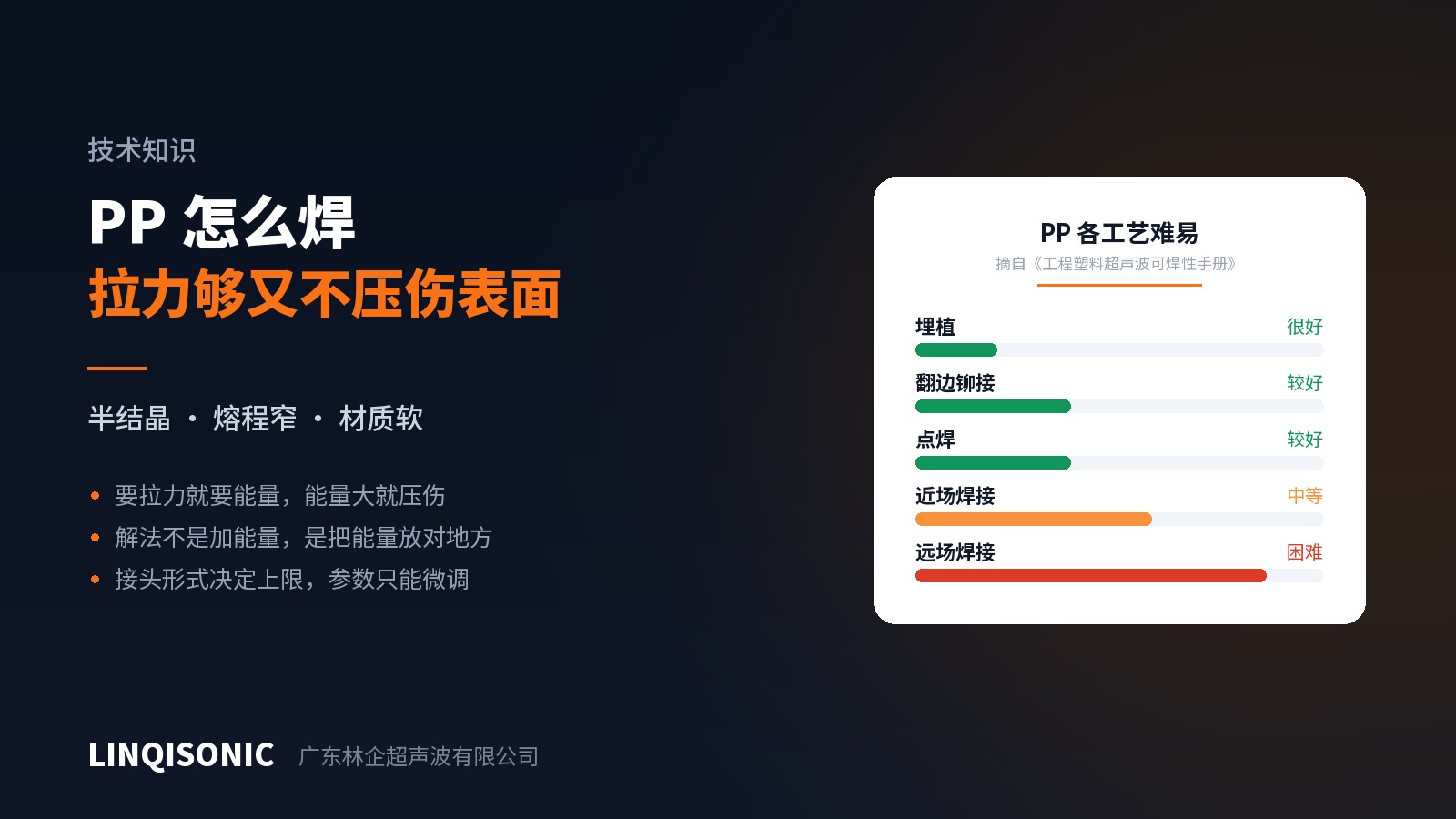
Higher crystallinity, lower modulus and lower surface energy. The wave will not travel, the force will not seat, and the interface resists bonding — all three at once.
Plating, paint or ink on the joint puts a layer at the interface that takes no part in fusion. The answer lies in the process sequence and in masking, not in the parameters.
The better the nest fits, the more easily air is trapped. With nowhere to go at the moment of clamping, the part floats and the weld height varies part to part.