
Welding PMMA: Easy to Fuse, Easy to Mark
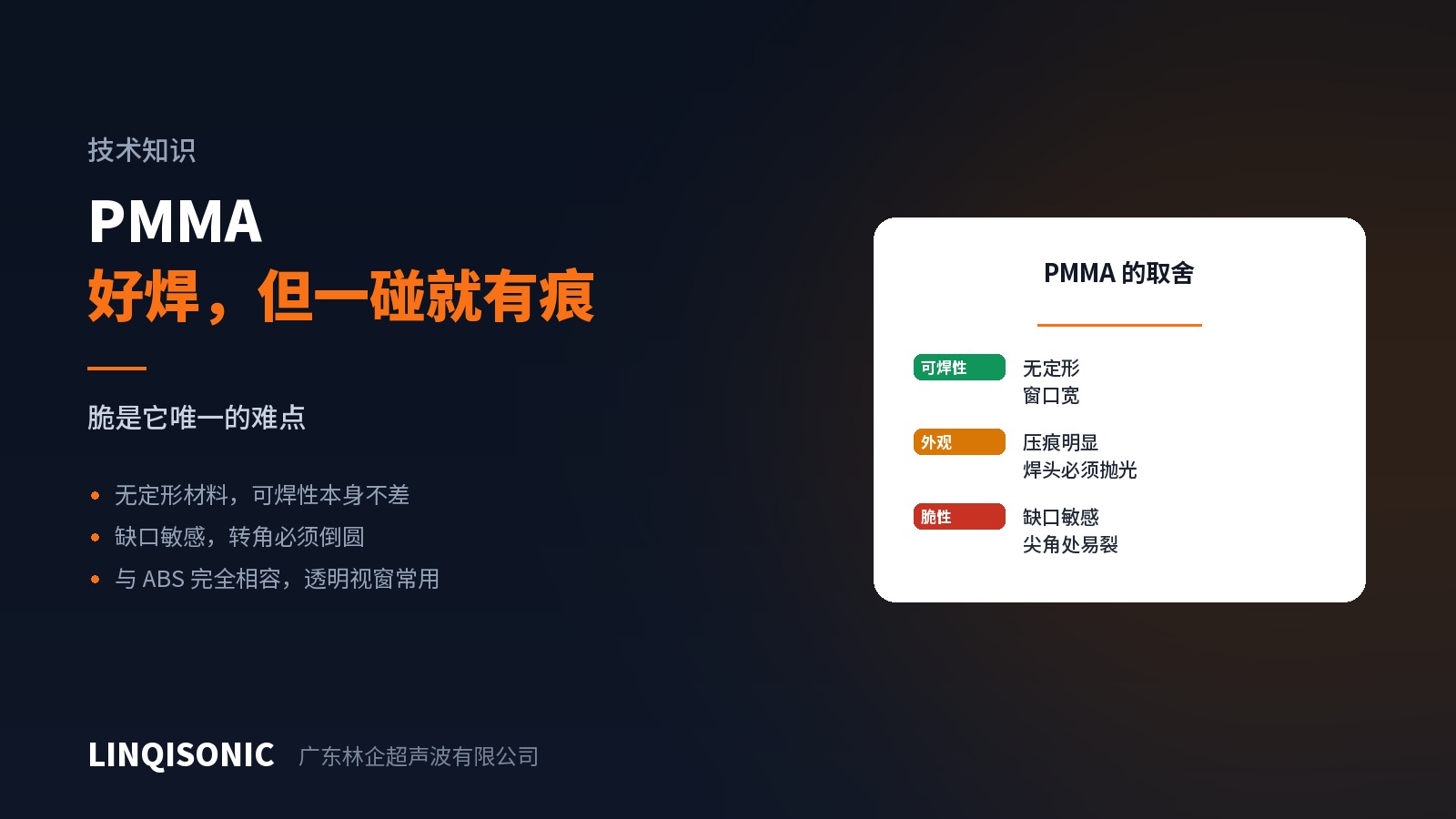
PMMA counts as an easy material to weld ultrasonically: amorphous, with no sharp melting point, a broad softening range and a much wider process window than semi-crystalline resins such as POM or nylon.
The difficulty is not fusing it. The difficulty is that it is brittle and transparent.
What brittleness costs
PMMA sits at the sensitive end of the notch-sensitivity range among common engineering plastics, and any stress concentration can start a crack:
Sharp corners on the joint — the root of an energy director and the corners of a shear joint both need radii. On PMMA this is not optional.
The edge of a horn impression — an impression edge is itself a notch, and a deep one readily develops into a crack.
Fixture contact points — hard locating points press in local stress; consider soft pads in the fixture.
Excessive interference — keep shear joint interference at the low end for PMMA. A dependable seal does not need a large interference.
What transparency costs
PMMA is generally chosen where transparency matters — panels, lenses, light guides, windows. Which means:
The horn face must be polished. Any texture transfers.
Plan the joint position early. Conceal it where possible; where not, accept on the drawing that it will be seen and make it neat.
Flash needs a trap. Flash is unusually conspicuous on clear parts, and expecting parameters alone to eliminate it is generally unrealistic.
Judge whitening separately. Whitening on PMMA is mostly stress-related; reducing energy will not help, reducing force and interference will.
Parameter direction
Force on the low side — the single most important setting for PMMA. Excessive force brings marking, stress whitening and cracking all at once.
Moderate amplitude. Amorphous materials are not fussy here, and there is no need to push high as with POM.
Slow approach. Impact at contact is a common trigger for cracking in PMMA.
Adequate hold. Letting melt solidify slowly under force reduces internal stress and the whitening that emerges later.
Compatibility
PMMA is fully compatible with ABS, a pairing widely used where a transparent window is needed — a clear PMMA panel welded straight onto an ABS housing in one operation.
Compatibility with PC is limited. Both are amorphous and transparent, but that does not make them weldable to each other; trial before committing.
One more thing
PMMA and PC are both loosely called acrylic or plexiglass, yet they are entirely different materials that weld very differently: PC is tough and impact-resistant but prone to stress cracking; PMMA is hard, brittle and surface-hard. Confirm which one you actually have before setting up — this mix-up is more common than it should be.
The full compatibility reference is in the handbooks on the downloads page. Force and approach speed control are described on the ultrasonic welding machine pages. Send drawings and appearance requirements to 1427498429@qq.com, or call +86 769 8202 9510 / +86 137 6001 0932.