
ABS Is the Easiest to Weld, and Carries the Most Traps
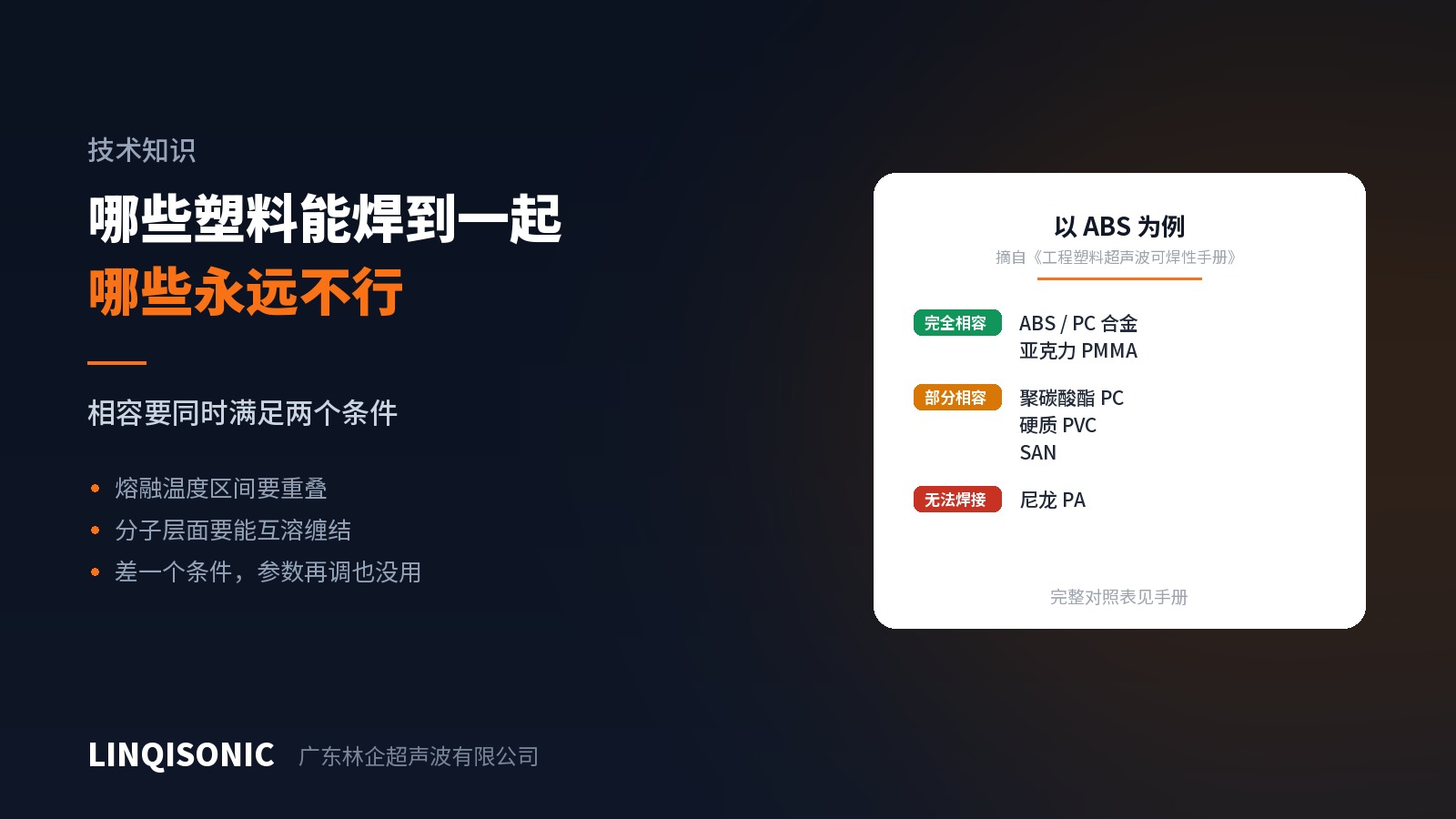
ABS is the most common and the easiest resin in ultrasonic welding: amorphous, with a broad softening range and a gradual transition from soft to flowing, and a far wider process window than semi-crystalline materials. Being easy is exactly why its traps differ from other resins.
Trap one: fused is not bonded
A wide window means that even with too little energy the interface softens and conforms under force, and the part looks entirely normal. Softening is not fusion, though: the chains have not diffused and entangled, and that is a cold weld.
Cold welds are harder to spot on ABS than on other resins. A semi-crystalline material short of energy usually fails to join at all and opens by hand; ABS produces a middle state that looks welded, resists a hand pull, and leaks the moment it is pressure tested.
There is only one way to identify it: section the joint and see whether the fused band is continuous. A genuinely fused joint tears the parent material on failure and leaves a rough face; a cold weld separates cleanly along the interface. Watch the scatter in pull strength too, which grows before the mean falls.
Trap two: chasing appearance produces cold welds
This is the common path. To eliminate flash and marking, energy is reduced step by step until nothing shows, and that point frequently lies below the fusion threshold.
Appearance and fusion are separate criteria and must be confirmed separately. After settling appearance, go back and verify destructively; a clean look is not a pass.
Trap three: compatibility invites mix-ups
ABS is fully compatible with PMMA and partially compatible with PC, rigid PVC and SAN. The side effect is that the wrong resin also welds.
ABS and ABS/PC alloy look similar and mix without being noticed, but their softening temperatures differ, so the same settings give different and unstable strength. Incoming labelling and segregated storage matter more in an ABS shop than elsewhere.
Partially compatible pairings share a trait: they weld, but the window is narrower than like-to-like and the strength lower. ABS to PC can be done, but not where the joint carries load or must seal, and it needs re-validating after a batch change.
Trap four: pigment and regrind are underestimated
Because the window is wide, many shops assume a colour change needs no re-tuning. A black grade with heavy carbon black and a natural grade do not respond identically to energy; the difference is simply masked by the window. Then a batch arrives with more regrind, the effects stack, and the boundary is crossed.
Confirm parameters per colour and write the regrind ratio into the work standard; it is the least troublesome route.
The positive side
For all these traps, ABS remains one of the easiest choices. It is not fussy about near or far field, and far-field welding succeeds far more readily than on semi-crystalline resins; it is relatively forgiving about fixture stiffness; and it is insensitive to amplitude, without needing the high settings that POM or PPS demand.
Large housings use ABS and ABS/PC heavily precisely because it transmits well and tolerates variation. Use that wide window to absorb incoming variation, not to skip verification.
The compatibility matrix and difficulty ratings are in the weldability handbook on the downloads page. Multi-dimensional monitoring is on the ultrasonic welding machine pages.
Send the grade, colour and regrind ratio to 1427498429@qq.com, or call +86 769 8202 9510 / +86 137 6001 0932.