
Ultrasonic Rotary Welding of Nonwovens: Pattern Wheel, Speed and Force
Continuous-web products — masks, wipe packaging, hygiene materials, filter bags — cannot stop for each weld and run rotary ultrasonic welding instead, with material passing continuously between a fixed horn and a rotating pattern wheel.
Those patterns are not decoration
The diamonds, dots and stripes embossed on nonwoven products are often taken for styling. In fact they are the impressions of raised points on the wheel, and where the points are is where the welds are.
Those points do exactly what an energy director does in plastic welding: concentrate energy onto limited contact areas. A perfectly smooth wheel spreads energy across the whole face, welding nothing securely while stiffening and flattening the web.
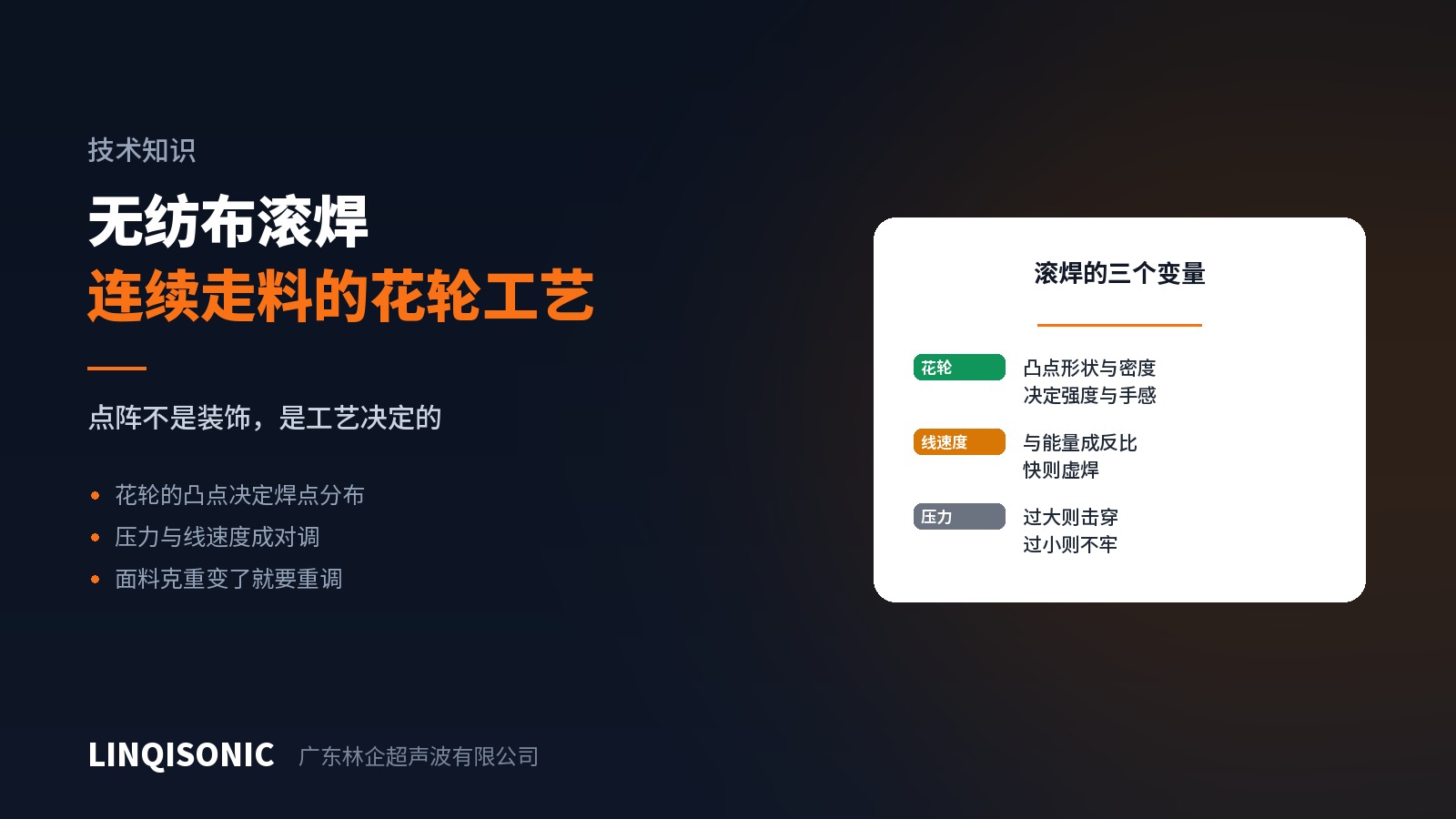
Denser points — more welds and more strength, but a stiffer web with reduced breathability.
Sparser points — a softer hand and better air flow, but less strength.
Wheel selection is therefore a trade between strength and hand, and a wheel for mask ear loops is nothing like one for filter bag side seals.
Line speed pairs with energy
Rotary welding has no weld time parameter. Line speed takes its place, since how fast material passes through the weld zone sets how long each point receives energy.
Faster = less energy per point = cold welds.
Slower = more energy per point = burn-through, stiffening, yellowing.
So output cannot be raised by speed alone; change speed and amplitude and force must both be re-established. This is where rotary set-up most often goes wrong — speed raised on its own to chase output, and a whole run comes off with insecure seals.
What force does
Force comes from the gap between horn and wheel and the clamping arrangement. Too much and the points punch straight through, leaving holes; too little and contact is incomplete so energy cannot transfer.
Force must also be uniform across the full width. When wheel and horn are not parallel, one side welds and the other does not — the most common fault on wide material.
Change the web and re-establish everything
Any change in basis weight, fibre composition or number of layers calls for re-validation.
Fibre composition especially: PP and PET nonwovens soften at different temperatures and cannot share parameters. Where a laminate combines different materials per layer, compatibility applies as well — incompatible layers are pressed together rather than welded.
In blends containing non-melting natural fibres such as cotton or viscose, beyond a certain proportion the seal will not hold, because too little thermoplastic remains at the interface to fuse. That is set by the material and cannot be solved with parameters.
Daily checks
Embossing clarity. The same logic as impressions in metal welding — a blurred pattern means a worn wheel or insufficient force.
Peel test. Tear a sampled seal open and see whether fibres break (welded) or the seam parts cleanly (merely pressed).
Check both edges of the width. Good in the middle and poor at the edges is the classic parallelism signature, so do not sample only the centre.
Clean the wheel regularly. Fibre and melt residue accumulate between the points, and a packed wheel is a wheel with shorter points.
Frequencies, working widths and wheel options are on the ultrasonic welding machine pages. Send web composition, basis weight, width and required line speed to 1427498429@qq.com, or call +86 769 8202 9510 / +86 137 6001 0932.