
PET and PBT: Same Family, Different Behaviour
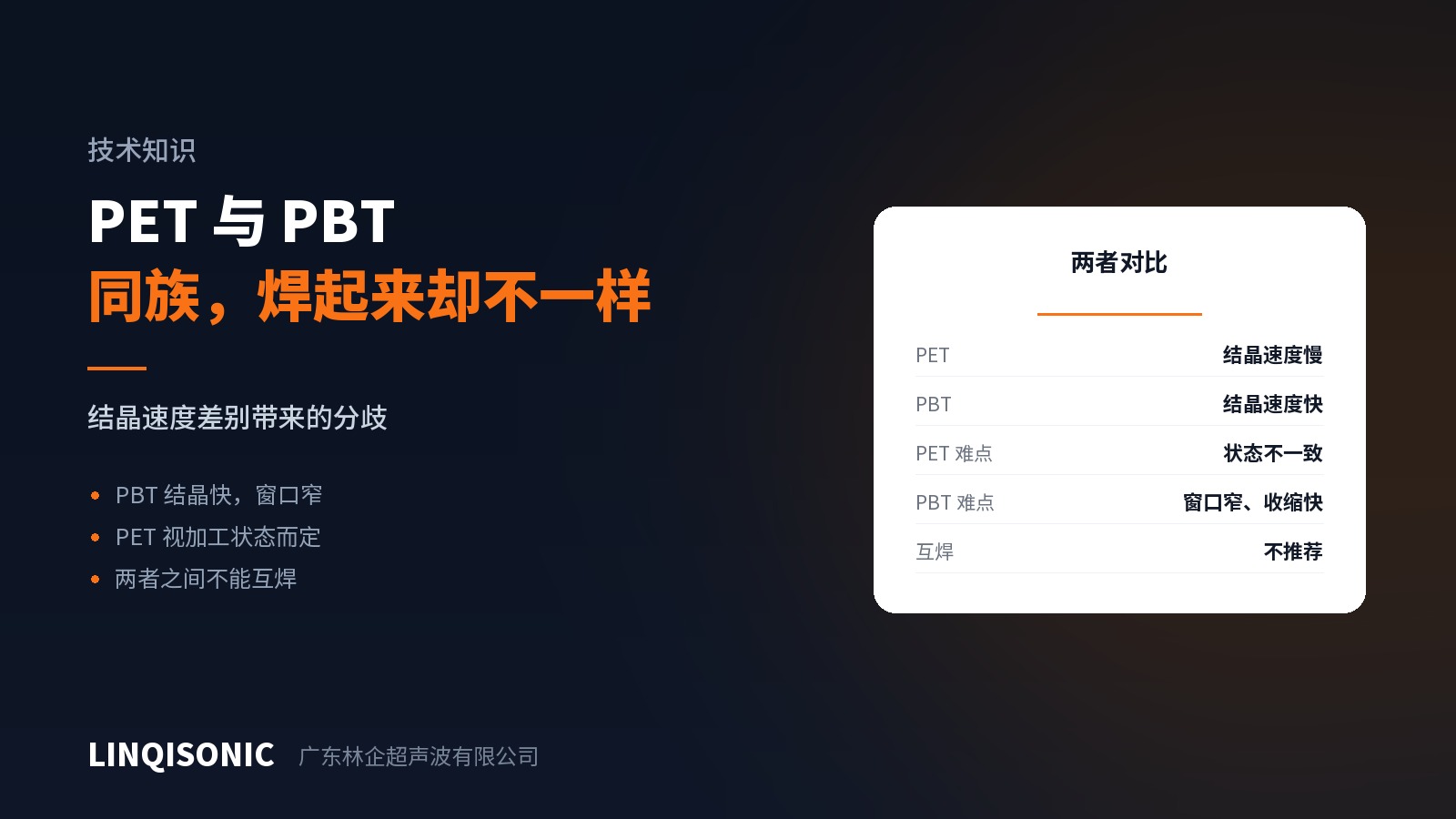
PET and PBT are both polyesters with similar chemistry, and are often assumed to weld alike. They do not, and the reason is crystallisation rate.
PBT: fast crystallisation, narrow window
PBT crystallises quickly. Once melt leaves the melting temperature it solidifies rapidly, which for ultrasonic welding means:
Short melt life. Bonding has to complete promptly after the interface melts, or the melt sets first. PBT is therefore demanding about the timing of hold — force must follow the end of vibration with no gap.
A narrow window. As with POM, there is little margin between under- and over-welding. Use energy or distance mode, not time.
Noticeable shrinkage. Crystallisation reduces volume, and insufficient hold leaves internal voids.
PBT is common in connectors and automotive electronics, where parts are frequently glass-filled as well — narrowing the window further.
PET: it depends on processing
PET crystallises far more slowly than PBT, so its state depends on thermal history:
Rapidly cooled PET (blow-moulded bottles, thin-wall injection) has low crystallinity, is nearly amorphous and clear, and behaves much like an amorphous material with a fairly wide window.
Slowly cooled or crystallised PET (CPET, such as heat-resistant trays) has high crystallinity, is opaque, and behaves as a semi-crystalline material with a narrow window.
The same PET grade can weld noticeably differently depending on mould temperature and cooling. This causes real confusion in set-up — parameters that worked on samples fail in production, usually because moulding conditions changed.
Do not weld one to the other
Related as they are, PET and PBT have different melting ranges and crystallisation behaviour, and the interface rarely reaches a suitable state on both sides at once. The usual result is contact rather than fusion.
Where a design pairs PET against PBT, unify the material at the design stage or use another joining method.
Parameter direction
PBT — medium to high amplitude, moderate force, short time, prompt and adequate hold, energy or distance mode, shear joint preferred.
PET — establish the crystalline state first. Treat clear material as amorphous with a relatively relaxed window; treat opaque material as semi-crystalline, following the PBT approach. Trial on parts made under production conditions rather than setting parameters from prototypes.
On glass filling
Structural PBT and PET are frequently glass-filled. As filler content rises, the proportion of resin available to fuse at the interface falls and weld strength drops. This is a material limit that equipment cannot make up, so design strength around the filled reality.
Compatibility and parameter guidance by material are in the handbooks on the downloads page. Hold control and mode options are on the ultrasonic welding machine pages. Send drawings, grade and filler content to 1427498429@qq.com, or call +86 769 8202 9510 / +86 137 6001 0932.