
15, 20, 30 and 40 kHz: Choosing an Operating Frequency
Frequency is one of the first specifications you meet. Is a bigger number more advanced? No. Frequency is a division of labour, not a ranking.
What frequency determines
Amplitude. At the same energy, higher frequency means less displacement per cycle. Amplitude at 40 kHz is typically around half that at 20 kHz, and less amplitude means a gentler mechanical action on the part.
Available power and weld area. Lower frequency allows a larger horn, driving more area with more available power. The relationship is geometric — horn length ties to half a wavelength, so a higher frequency demands a shorter, smaller horn.
Transmission distance. Lower frequencies attenuate less in plastic, making far-field welding, where the horn contacts well away from the joint, easier to achieve.
Roughly where each sits
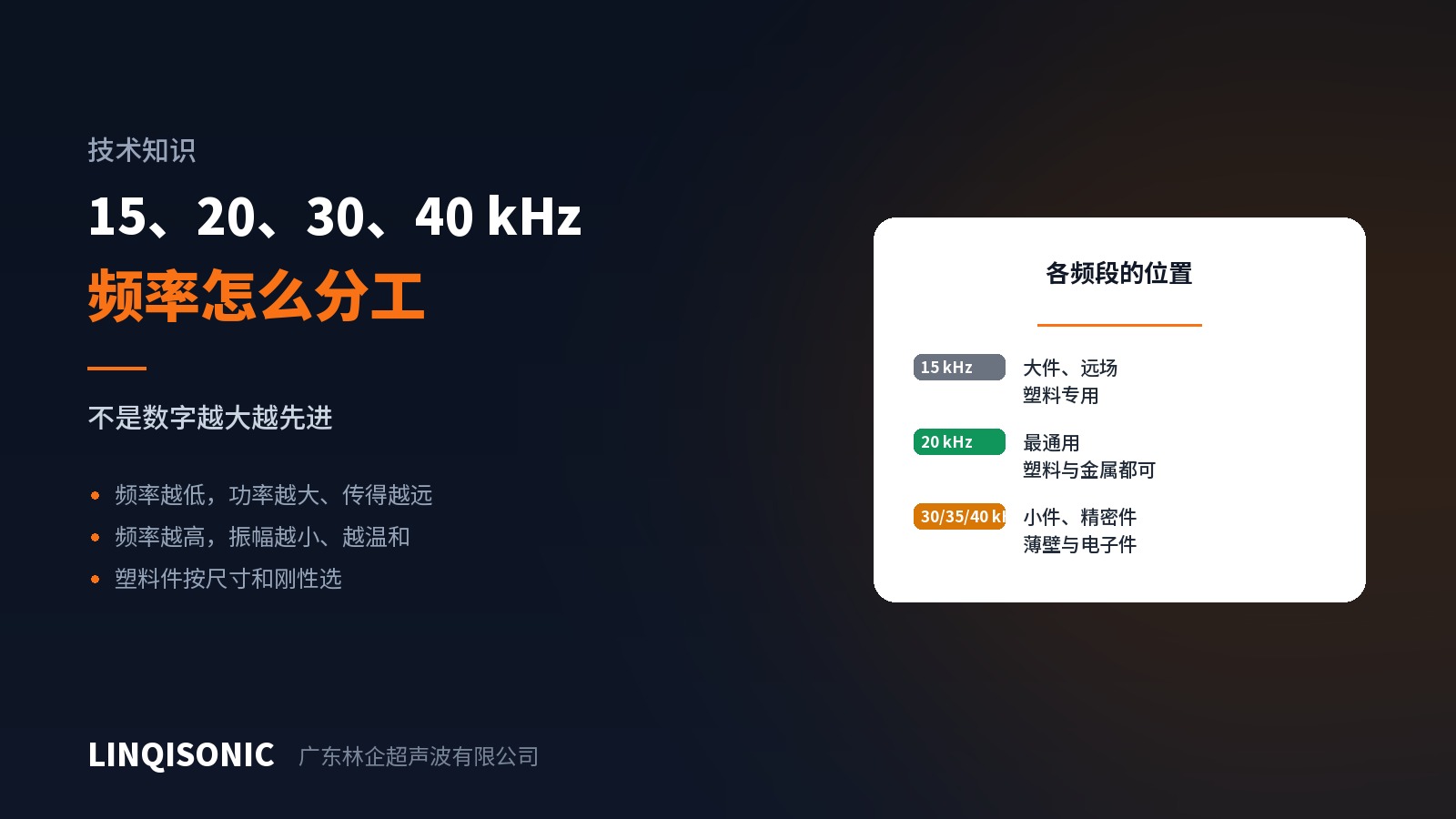
15 kHz — the low band, for plastics only. Very large horns are possible, suiting large plastic parts, far-field welding, and semi-crystalline materials that need stronger energy transmission. Not used for metal welding.
20 kHz — the general-purpose band. It covers plastic parts from medium to fairly large, and is the mainstay for metal welding. Most production lines run at this frequency.
30 / 35 kHz — the middle ground. Less weld area than 20 kHz but gentler amplitude, suiting small and medium precision parts.
40 kHz — small and precision parts. The lowest amplitude, kindest to thin walls, clear parts and housings containing electronics. The trade-off is a low ceiling on power and area; large parts are out of reach.
Choosing for plastics
Start with size: a long joint perimeter or large weld area points lower.
Then sensitivity: thin walls, clear parts, precision components inside, marking concerns — all point higher.
Where the two conflict, decide which dominates. Large thin parts are the hardest case and are usually solved by fixturing and support rather than by frequency.
Metals differ
Metal ultrasonic welding commonly uses 20, 30, 35 and 40 kHz. Large sections such as busbars and battery tabs sit at 20 kHz; fine wire harnesses and small spot welds move higher.
Changing frequency means changing everything
Frequency is a property of the whole acoustic system. Changing it means a different generator, converter, booster and horn — not a setting. Decide it during selection.
Given typical part size, material and sensitive features, the choice is usually clear. Available frequencies by machine are on the ultrasonic welding machine pages; drawings can go to 1427498429@qq.com, or call +86 769 8202 9510 / +86 137 6001 0932.