
Hold Time: Why That Extra Second Cannot Be Skipped
When cycle time is under pressure, hold time is the first parameter to be cut. That is usually a mistake.
When ultrasound stops, the joint is still liquid
It is widely assumed that the weld is complete once ultrasound ends. In fact the joint is molten at that moment and its strength is close to zero.
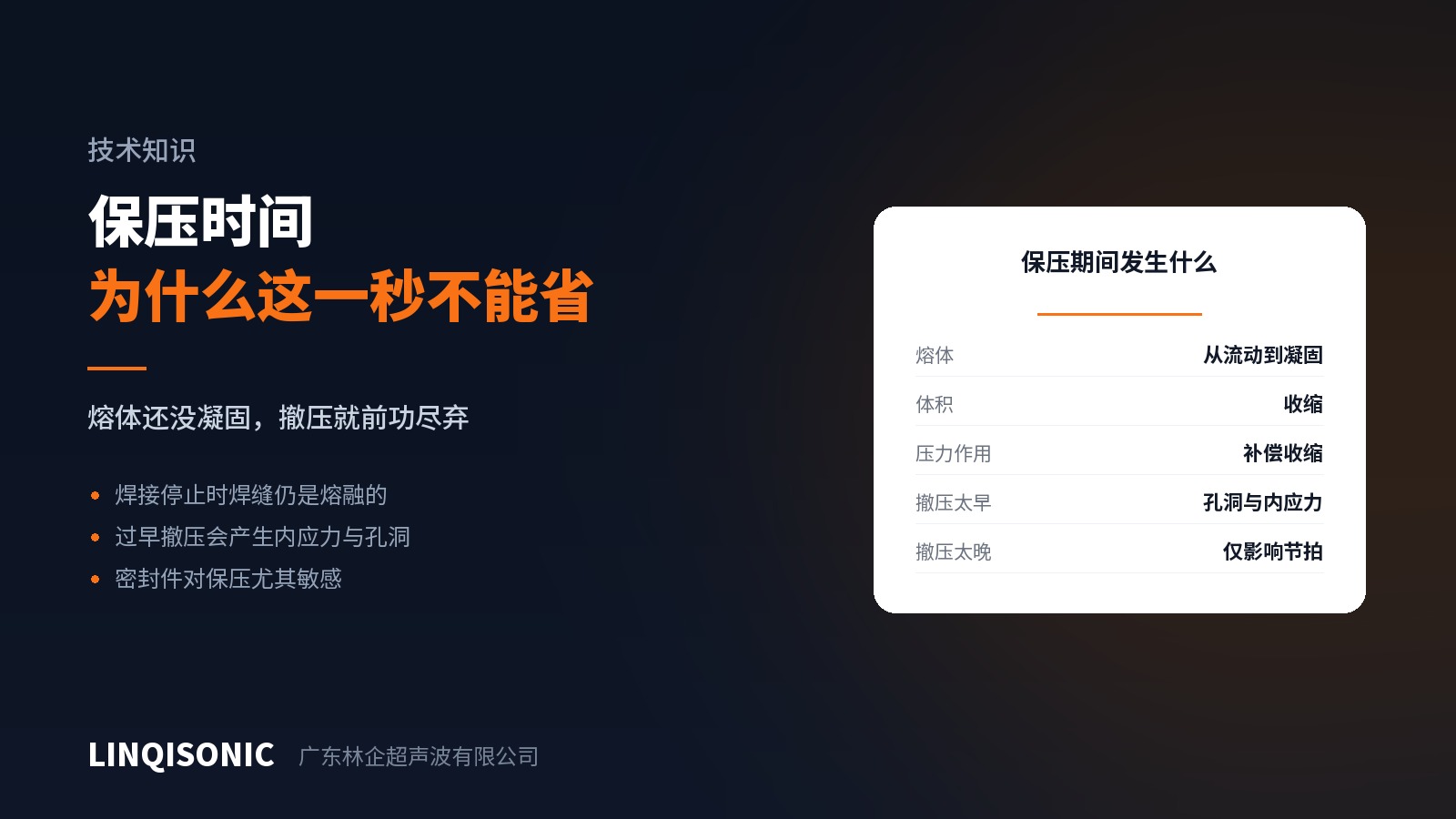
Over the next few hundred milliseconds three things happen: the melt cools, it begins to solidify, and it shrinks. Hold time exists to keep force applied through that process, holding the faces together and compensating for shrinkage.
What happens if force is released early
Voids form inside the joint. Solidifying melt contracts, and without sustained force the space left by that contraction becomes a void. Nothing shows externally, but seal integrity and strength are lost there.
Stress is locked in. If the faces move or spring back during solidification, the resulting joint contains internal stress. It is invisible in normal use and becomes a crack initiation site under thermal cycling, drop loading or sustained load.
The part springs back. Plastic parts deform elastically under weld force; release too early and the recovering part tears apart a portion of the freshly formed bond before it has set. Thin walls and long spans show this most.
Where longer hold is needed
Thick sections — more melt, slower cooling.
Semi-crystalline resins — nylon, POM and PP shrink more on solidification than amorphous grades and are more sensitive to hold.
Sealed parts — any uncompensated shrinkage is a potential leak path.
Large weld areas — more total heat and longer to dissipate.
Flexible parts — greater springback, so force must be held until the joint has genuinely set.
How to tell whether it is enough
Shorten hold time progressively and watch for the onset of problems — usually appearing first as seal failures or increased scatter in strength rather than as a fall in mean strength. Scatter reveals the problem earlier than the average does.
The other method is to section a sample and inspect the joint. Insufficient hold shows as voids or incompletely bonded regions on the cut face.
A related function
Some machines offer an afterburst — a short additional ultrasound pulse during the hold phase. It adds a small amount of energy as the melt begins to solidify and can improve bonding on certain materials. It is not universal: applied poorly it re-melts already solidified material, so it needs validation for each case.
Hold control and afterburst by machine are on the ultrasonic welding machine pages. Send material and wall thickness to 1427498429@qq.com, or call +86 769 8202 9510 / +86 137 6001 0932.