
Why Automotive Harnesses Are Moving from Crimping to Ultrasonic Welding
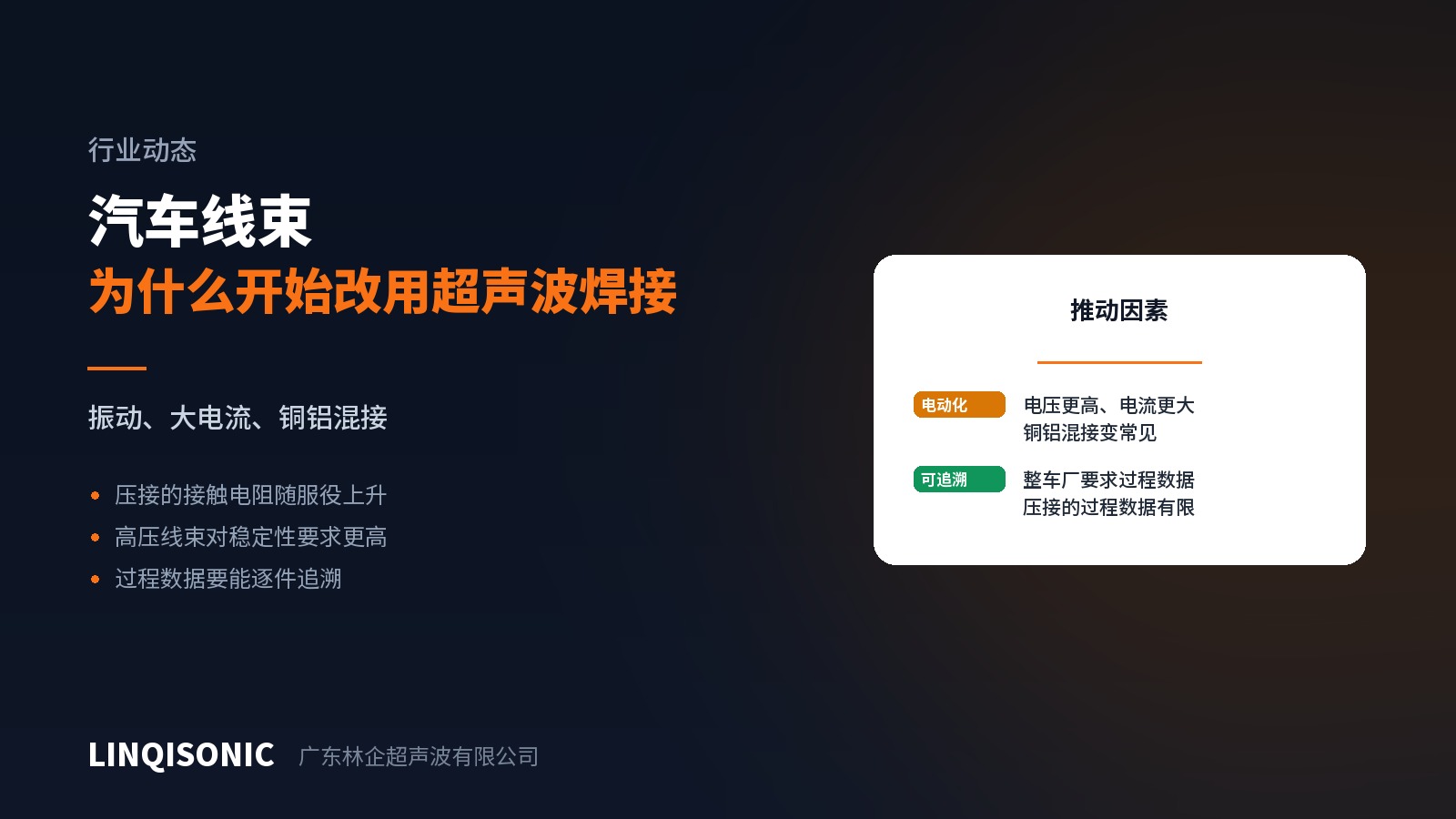
Splices and terminations in automotive harnesses have long been dominated by crimping. That is changing, and the main driver is electrification.
Electrification changed the duty
Currents are higher. Traction and fast-charge circuits run at current levels far above traditional vehicle electrics. Heating from joint resistance scales with the square of current, so the same resistance has quite different consequences.
Copper-to-aluminium is now common. Aluminium conductors and terminals are increasingly used to save weight and cost. Crimped copper-aluminium joints suffer galvanic corrosion within the crimp gaps — one of the hardest conditions for crimping to handle.
Vibration has not improved. The vehicle's vibration spectrum is unchanged, while a crimp maintains contact through elastic recovery. Vibration causes fretting, thermal cycling relaxes the force, and both slowly weaken the contact.
How crimped joints age
A crimp is mechanical contact, and microscopic gaps always remain. A fresh joint can have very low resistance, but in service, oxidation within the gaps, fretting and force relaxation raise contact resistance slowly. Higher resistance causes heating, and heating accelerates the process.
It is a gradual, self-reinforcing loop. Failure is usually not disconnection but long-term degradation — precisely the mode hardest to catch within a warranty period.
What welding changes
Ultrasonic metal welding is solid state: vibration disperses the surface oxide and clean metal forms metallic bonds. The interface is no longer two pieces of metal held together but one continuous piece.
No gaps means no gap oxidation and no fretting; no elastically maintained force means no relaxation. And with no melt pool, no brittle intermetallics form between copper and aluminium.
The second driver: traceability
OEM requirements for process data on critical joints continue to tighten. Crimp quality is judged largely by crimp height and sample pull testing, which leaves limited process data behind.
Ultrasonic welding can set monitoring limits on energy, power, force and pre/post-weld height for every cycle, alarm on deviation and record part by part. That serves quality and traceability at once.
Not a wholesale replacement
Crimping retains clear advantages: low equipment cost, fast cycle, standardised terminals and easy field repair. For small cross-sections, low current and non-critical circuits it remains the sensible choice.
The switch happens where current is high, copper meets aluminium, vibration is severe, or traceability is required. The test is not novelty but whether joint resistance will stay stable across the service life.
Our harness welding equipment covers copper harnesses and terminals across a range of cross-sections; see the ultrasonic welding machine pages.
Send cross-section, material, joint configuration and current rating to 1427498429@qq.com, or call +86 769 8202 9510 / +86 137 6001 0932.