
PE Is Harder to Weld Than PP, and Here Is Why
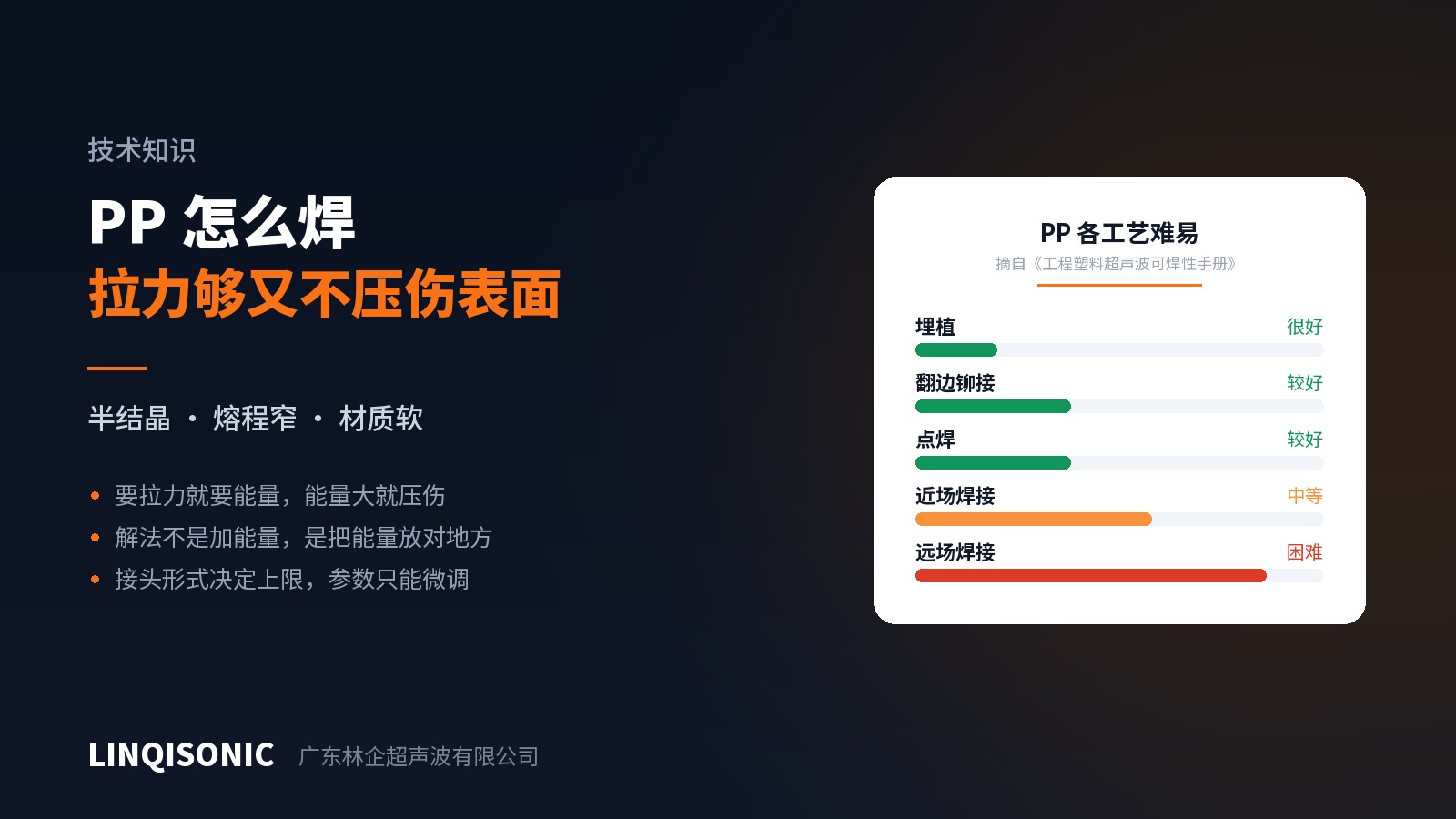
PP already counts as a difficult resin, and PE is harder still. Both are polyolefins, and the difference is worth spelling out.
Three effects stacked
Higher crystallinity. PE, and HDPE especially, is more crystalline than PP, with a narrower melting range and more heat absorbed to break down the crystalline order. For the same joint, PE needs a higher energy density.
Lower modulus. PE is softer than PP, so the part deforms before the interface loads. You believe you are pressurising the joint while the travel is absorbed by elastic deformation. LDPE shows it more.
High damping and poor transmission. Polyolefin chains are mobile and the wave attenuates quickly. Far-field welding on PE is essentially unworkable; the horn has to press near the joint.
What to do
Design for near field, always. The first and most important point, settled on the drawing. A design where the horn cannot reach near the joint cannot be rescued later.
Use a shear joint. An energy director relies on instantaneous melting at a tip followed by flow, and the narrow PE melting range makes that instant hard to reproduce. A shear joint uses sustained friction along an interference fit and advances progressively.
Give it enough amplitude. Semi-crystalline resins need extra heat to break down crystalline order, and PE more so. Where amplitude is short, extending the cycle achieves nothing but spreading heat into the body.
Support the part closely. PE is soft and sinks where support is inadequate, so real pressure varies along the joint. The nest should follow the contour and support by shape rather than on a few points.
Hold longer. PE shrinks considerably, so force must stay applied until the fused zone has genuinely set, or voids remain and sealed parts leak.
Insertion and staking suit it better
In the weldability ratings, PE and PP score poorly for welding but very well for insertion. Insertion does not require the two sides to fuse; it only requires the resin to melt and refill a knurl, which is far easier for a polyolefin.
Staking follows the same logic: the captured part takes no part in fusion, so compatibility is not required. Where a PE part must join metal, a PCB or an incompatible plastic, staking is the clean answer.
So when a PE part needs joining, do not assume welding. Check first whether staking, or insertion plus a screw, fits better.
Compatibility
PE and PP do not weld to each other. Both are polyolefins and look like relatives, but their melting points and molecular structures differ and no continuous bond forms at the interface. Designing a PE part to weld to a PP part is a common error.
PE welds to PE, and even among HDPE, LDPE and LLDPE the specific grades matter; cross-density combinations have to be trialled before they count.
Difficulty ratings across welding, staking, insertion and spot welding, with the compatibility matrix, are on the downloads page. Amplitude ranges, hold control and fixture options are on the ultrasonic welding machine pages.
Send the grade, density and drawings to 1427498429@qq.com, or call +86 769 8202 9510 / +86 137 6001 0932.