
PA6 and PA66: Where the Welding Differs
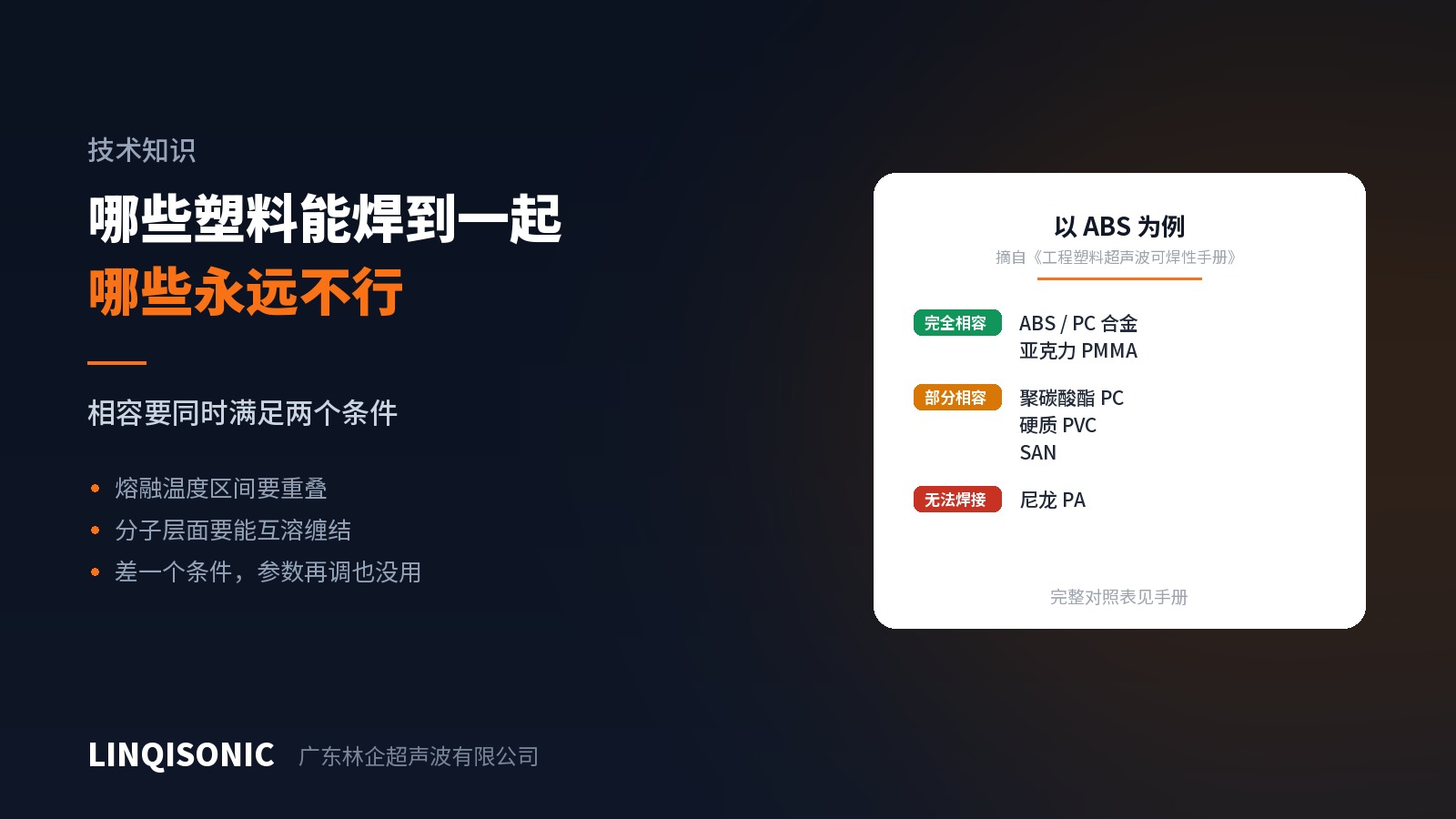
Writing "nylon" on the drawing is not enough. PA6 and PA66 behave noticeably differently under ultrasonic welding, their parameters do not transfer, and the two will not weld to each other.
The difference starts at the melting point
PA66 melts about 40 degrees higher than PA6, crystallises faster and has a narrower melting range. Semi-crystalline materials already lack the broad softening region of amorphous resins, and PA66 pushes that further: below the melting point it is solid, above it the material flows quickly, and the usable interval in between is narrow.
In welding terms, PA66 needs a higher energy density to open the interface, and once that is exceeded the resin near the joint degrades quickly. Carrying a parameter set from PA6 to PA66 usually produces an unfused joint; going the other way usually produces flash and yellowing.
PA6 has a somewhat wider melting range and more tolerance, but it is still semi-crystalline and nothing like an amorphous resin such as ABS.
The two do not weld to each other
This belongs in the design decision. The melting points are far enough apart that one side is already flowing while the other is still solid, so there is no moment that suits both. Even a joint that looks closed is only pressed together, and it separates under load.
So where one half is PA6 and the other PA66, do not expect parameters to solve it. Change the material, or change the joining method to insertion with a screw, or to staking.
Glass fibre widens the gap
Structural nylon parts are rarely unfilled. Glass fibre attenuates the acoustic wave and also takes up resin that would otherwise fuse at the interface, and both effects land on a material whose melting range is already narrow, so the process window closes fast.
Beyond a certain loading, more amplitude is no longer enough and the joint form has to change. An energy director depends on instantaneous melting at a tip followed by flow, and fibre weakens both; a shear joint generates heat through sustained friction along an interference fit and is far less sensitive to fibre.
Work through it in order
Confirm the grade first. PA6 or PA66, filled or not, and at what loading. Until those three are answered, everything downstream is guesswork.
Joint form before parameters. Semi-crystalline resins suit a shear joint, and filled PA66 more so. That decision is made on the drawing; once the tool is cut there is little room left.
Amplitude before time. Amplitude governs the energy density reaching the interface per unit time. Extending the cycle only gives heat more opportunity to spread into the part body while the interface stays unfused.
Make the fixture rigid. A narrow window means repeatability matters. If the part can move in the fixture, the energy path differs piece to piece and the result drifts.
One more thing
Within the same grade, a new batch can differ in fibre content, length distribution and sizing chemistry, and nylon is far more sensitive to that than ABS. Re-confirm parameters after a batch change rather than assuming they carry over.
Difficulty ratings for engineering thermoplastics across welding, staking, insertion and spot welding, together with the compatibility matrix, are in the Weldability of Engineering Plastics handbook on the downloads page. Amplitude ranges and fixture options by model are on the ultrasonic welding machine pages.
To have a specific part assessed, send the grade and drawings to 1427498429@qq.com, or call +86 769 8202 9510 / +86 137 6001 0932.