
Ultrasonic Cutting Is Not Ultrasonic Welding
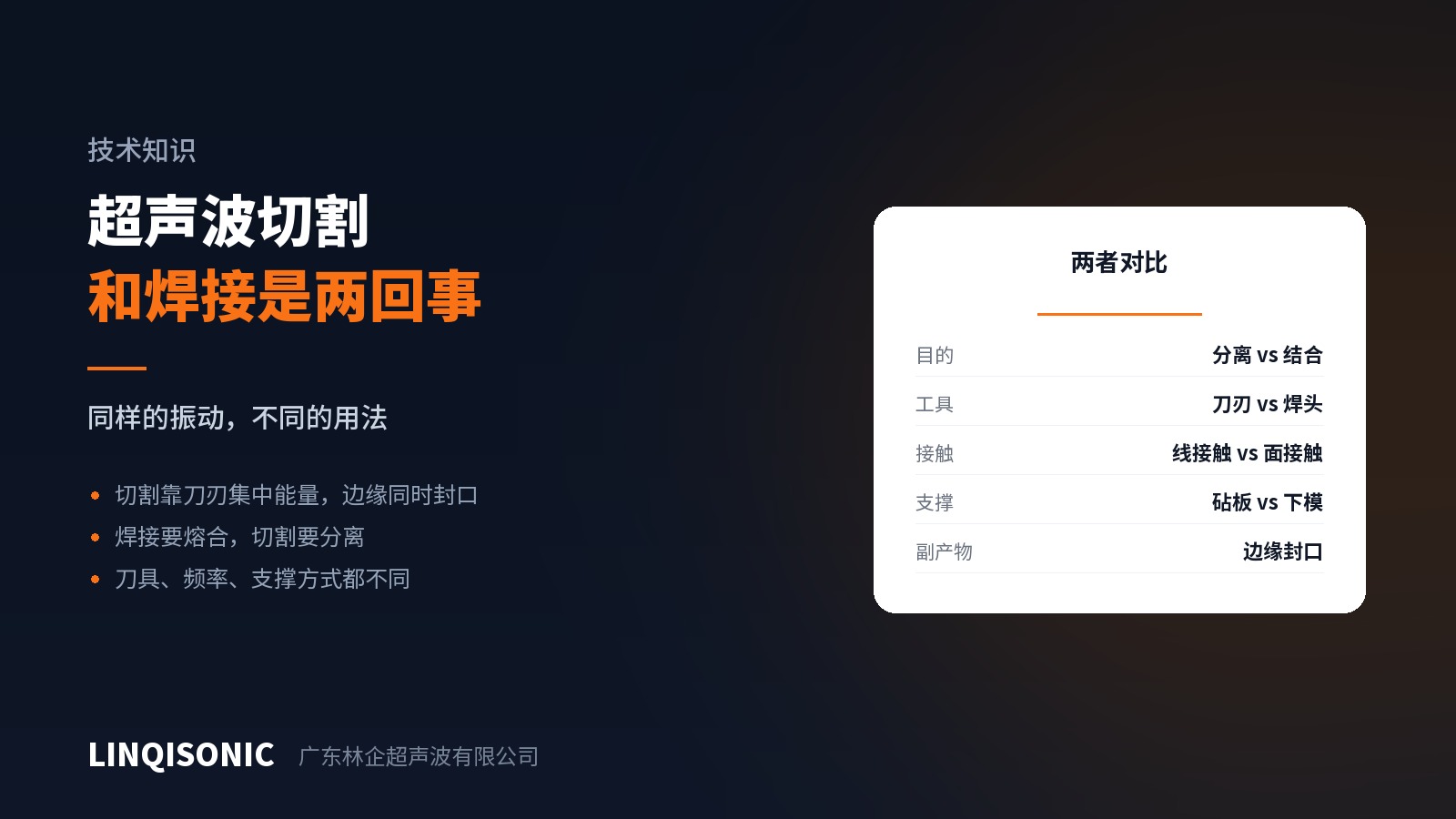
An ultrasonic cutter and an ultrasonic welder look much alike — the same generator, converter and booster. The difference is the component at the end, and what it is meant to achieve.
Different principles
Welding: the horn contacts over an area, energy spreads across that area, and the aim is to melt and fuse the interface.
Cutting: the tool is a blade, and energy concentrates along a line. The edge strikes the material at high frequency and softens it locally while advancing, and the material parts.
Because of that vibration, friction between edge and material falls sharply, so ultrasonic cutting needs far less downward force than an ordinary blade. That is its central advantage.
Where cutting wins
Soft, tacky, easily deformed materials. An ordinary blade pushes soft material ahead of it and crushes it; with low resistance, an ultrasonic cut is far cleaner. Rubber, foam, honeycomb and frozen food are typical.
Materials that stick to the blade. High-frequency motion keeps material from adhering, so confectionery, cheese and filled foods cut cleanly with less downtime for cleaning.
Sealed edges on thermoplastics. A useful side effect: material near the edge softens briefly, so thermoplastic fabrics and nonwovens are sealed as they are cut and do not fray. Valuable in garments and filter media.
Films and composites. Low force means thin material is less likely to wrinkle.
Common misconceptions
"Can it cut metal?" No. Ultrasonic cutting depends on local softening and tearing under high-frequency impact, which does not apply to metal. Its materials are plastics, rubber, textiles, food and paper products.
"Is the blade heated?" The blade itself is not. Heat comes from internal friction generated in the material by vibration, and is local and momentary. This distinguishes it from hot-knife cutting, which leaves a wider heat-affected zone and a pronounced scorched edge.
"Can a welder cut with a different tool fitted?" Generally not. Blade geometry, length and gain are designed for cutting rather than welding, and the feed arrangement — cutting often runs a continuous pass — and the support differ as well.
What matters in the tool
Edge angle governs cutting resistance and edge quality, and is chosen by material.
Blade length is constrained by half a wavelength just as a horn is, and cannot be ground shorter at will.
Edge wear shows up directly as a rough cut and rising force, making blades a consumable replaced by piece count.
Deciding whether it fits
If you currently use a plain or hot blade and meet any of the following, ultrasonic cutting is worth considering:
ragged cuts and material pushed out of shape;
frequent stoppages to clean material off the blade;
an unacceptable scorched edge or heat-affected zone from a hot knife;
a requirement for edges that do not fray without a second sealing operation;
thin soft material wrinkling under the blade.
Blade specifications, frequencies and feed arrangements are on the ultrasonic welding machine pages. Send material, thickness and edge requirements to 1427498429@qq.com, or call +86 769 8202 9510 / +86 137 6001 0932.