
Ultrasonic Insertion: Making Metal Inserts Stay Put
Where a plastic part needs a screw, the usual answer is a threaded metal insert. Ultrasonic insertion does that job quickly and cleanly — and loosening, tilting and split bosses are the most common complaints.
Almost all of it comes from the bore design, not from machine parameters.
How the insert is locked
The horn presses on the top face of the insert and transmits vibration into it. Friction where the insert meets the bore wall melts the resin locally; under force the insert sinks, and molten resin is displaced into the knurl on the insert's outside diameter, locking it mechanically once solidified.
Pull-out and torque resistance therefore come from how much resin refills the knurl and how strong it is once cool — not from how hard the insert is pressed.
Four features that decide the outcome
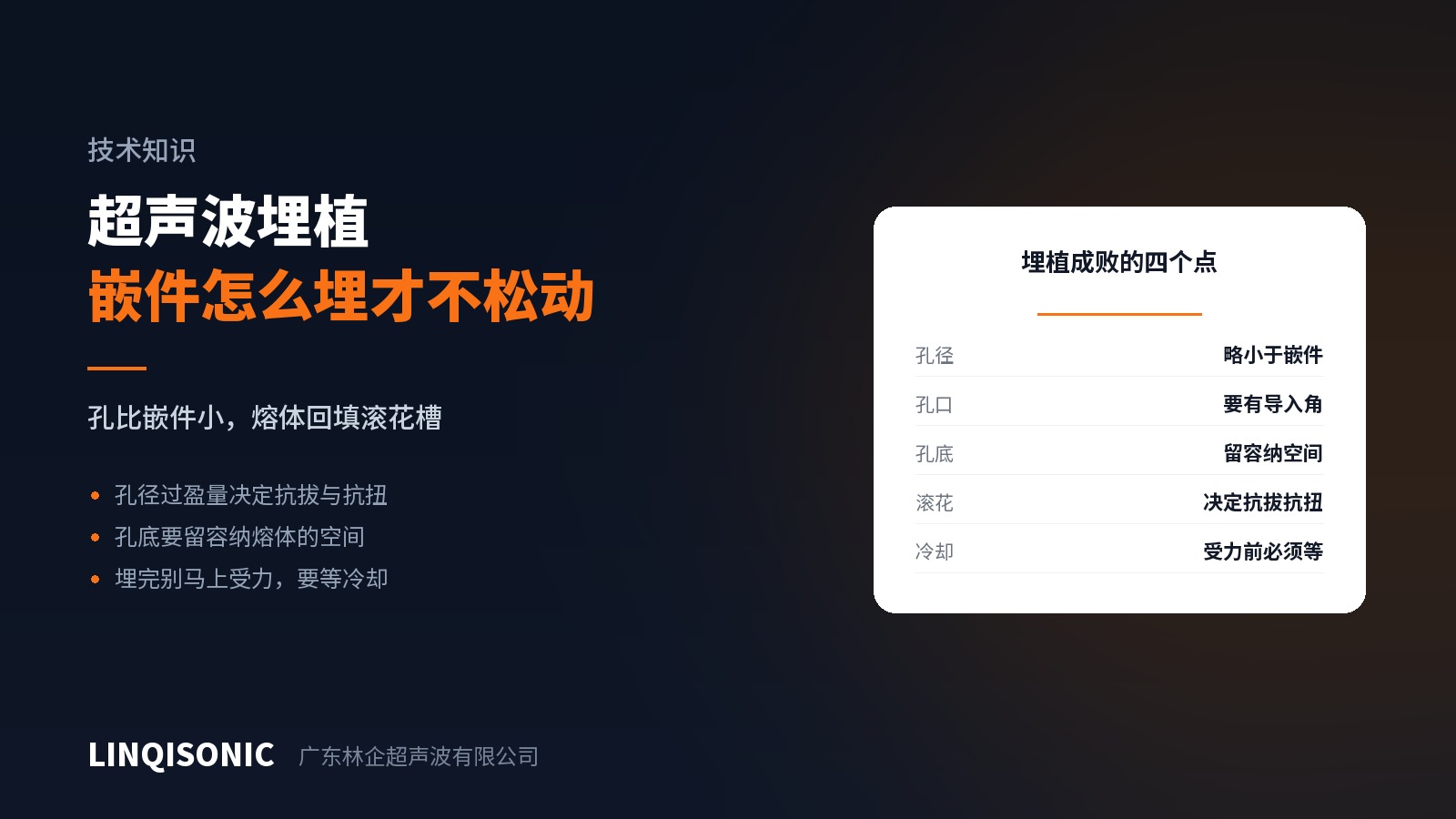
1. The bore must be slightly smaller than the insert. Too little interference and there is not enough melt to fill the knurl. Too much and there is too much material to displace, energy concentrates at the bore mouth, and the boss splits or the insert tilts. The right interference depends on the resin's modulus and shrinkage; there is no universal value.
2. The bore mouth needs a lead-in. Without a chamfer the insert bears hard on the bore edge as it starts to sink, concentrating stress and causing stress whitening or cracking. A small lead-in taper self-centres the insert and gives the first melt somewhere to flow.
3. Leave room at the bottom of the bore. The most commonly missed point. If bore depth equals insert length, displaced resin has nowhere to go but back up, lifting the insert or flashing out of the bore mouth. The bore should be slightly deeper, with a volume at the bottom to receive displaced material.
4. Match the knurl to the load. Circumferential knurl resists pull-out, axial knurl resists torque, diamond knurl does both but neither optimally. Choose by the load the part actually sees rather than by what happens to be in stock.
Three symptoms and their causes
Tilted insert — no lead-in, poor concentricity between horn and bore, or excessive interference producing uneven resistance.
Whitening or cracking at the bore mouth — excessive interference, too fast an approach, or a notch-sensitive resin (PC grades deserve particular care).
Tight at first, loose later — usually load applied before the joint had cooled, or melt filling only part of the knurl. Sectioning one sample to inspect the fill is far quicker than repeatedly adjusting parameters.
Material differences
In our Weldability of Engineering Plastics handbook, insertion rates well across the board — PP and PE, difficult to weld as semi-crystalline resins, perform very well in insertion. The reason is that insertion does not require the two sides to fuse; it only requires the resin to flow and refill, which is far more forgiving.
So when a material "cannot be welded", switching the connection to insertion plus a screw is sometimes the simplest answer.
Bore diameter and depth values, and interference bands by material, are in the handbook chapters — available from the downloads page. Equipment is on the ultrasonic welding machine pages.
Send insert specification and resin grade to 1427498429@qq.com, or call +86 769 8202 9510 / +86 137 6001 0932.