
Why Ultrasonic Metal Welding Does Not Melt the Base Metal
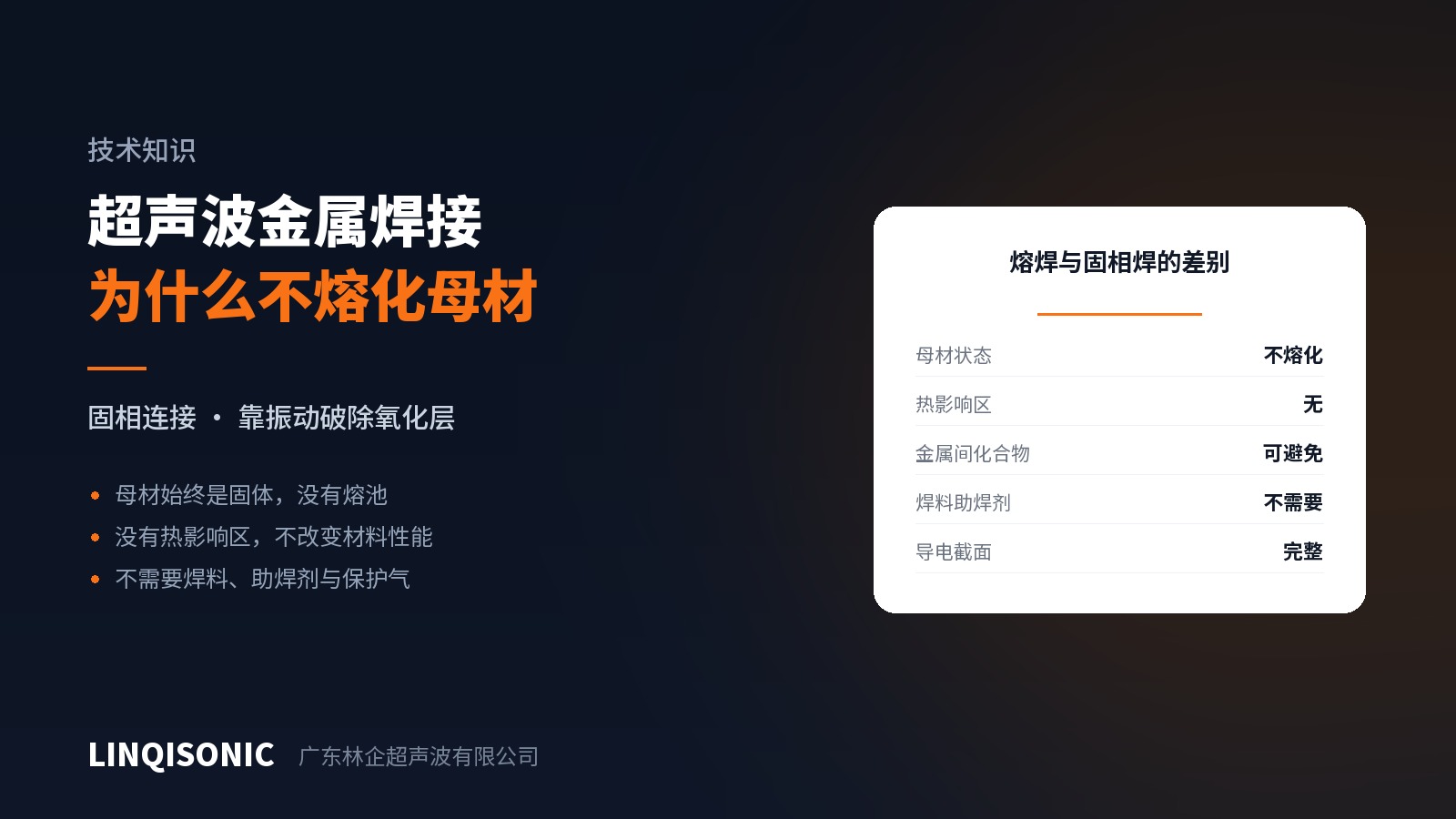
The question that comes up first with ultrasonic metal welding is usually the same: with no heating and no filler, how do two pieces of metal join at all?
The answer is that the process does not take the melt-and-solidify route.
What actually happens
During welding the horn presses the two workpieces together under a static force while vibrating laterally at more than twenty thousand cycles per second.
Metal surfaces always carry an oxide film along with adsorbed oil and moisture, and it is that film which prevents metal-to-metal contact. The first thing the vibration does is break the film up and displace it to the edges of the weld zone.
Once the film is gone, the fresh clean metal on each side is brought together under force, the atoms come within interaction range, and metallic bonds form directly. Temperature does rise — friction always generates heat — but stays well below the melting point. The base metal remains solid throughout; there is no weld pool.
That is what solid-state joining means.
What follows from not melting
No heat-affected zone. Fusion welding leaves a ring of thermally altered material around the weld, with grain growth and changed hardness and ductility. Solid-state joining puts in little heat, concentrated at the interface, so the structure and properties of the base material are essentially unchanged. That matters especially for work-hardened copper busbar and aluminium foil, where fusion welding would anneal away the strengthening.
Brittle intermetallics can be avoided. This is the crux of copper-to-aluminium joining. Once copper and aluminium melt together, cooling produces a family of hard, brittle intermetallic compounds; the joint looks welded but cracks under vibration. Without a melt pool, formation of those compounds can be held to a very low level.
The conducting cross-section stays intact. The weld is a continuous metallic bond with no filler layer, no trapped oxide and no porosity. For electrical connections, joint resistance is low and stable.
No consumables. No solder, no flux, no shielding gas — saving consumable cost and removing the flux-residue cleaning problem, which is a genuine nuisance in electronics and battery manufacturing.
Where the limits are
Solid-state joining is not universal, and its range is well defined.
It suits soft, conductive non-ferrous metals — copper, aluminium, nickel, gold, silver and their alloys. Steel and stainless can be welded but need considerably more energy and tighter conditions.
Thickness is limited. Vibration only helps once it reaches the interface, and a thick part consumes energy along the way. The natural territory is foil, thin sheet, wire harness and battery tabs — not structural sections.
The joint is essentially a lap joint. The process relies on relative motion between two parallel faces, so it suits lap configurations rather than butt joints.
Typical applications
Battery tabs and interconnects, wire-harness splices and terminals, copper busbar in transformers and motors, and sealing of refrigeration tubing. What these share: the joint must conduct or seal, the material is soft and thin, and neither filler contamination nor thermal damage can be tolerated.
Our ultrasonic metal welding equipment covers 20, 30, 35 and 40 kHz, selected by workpiece thickness and weld area. Models and specifications are on the ultrasonic welding machine pages.
Send drawings or samples to 1427498429@qq.com, or call +86 769 8202 9510 / +86 137 6001 0932.