
Can ABS Be Welded to Nylon? Judging Plastic Compatibility
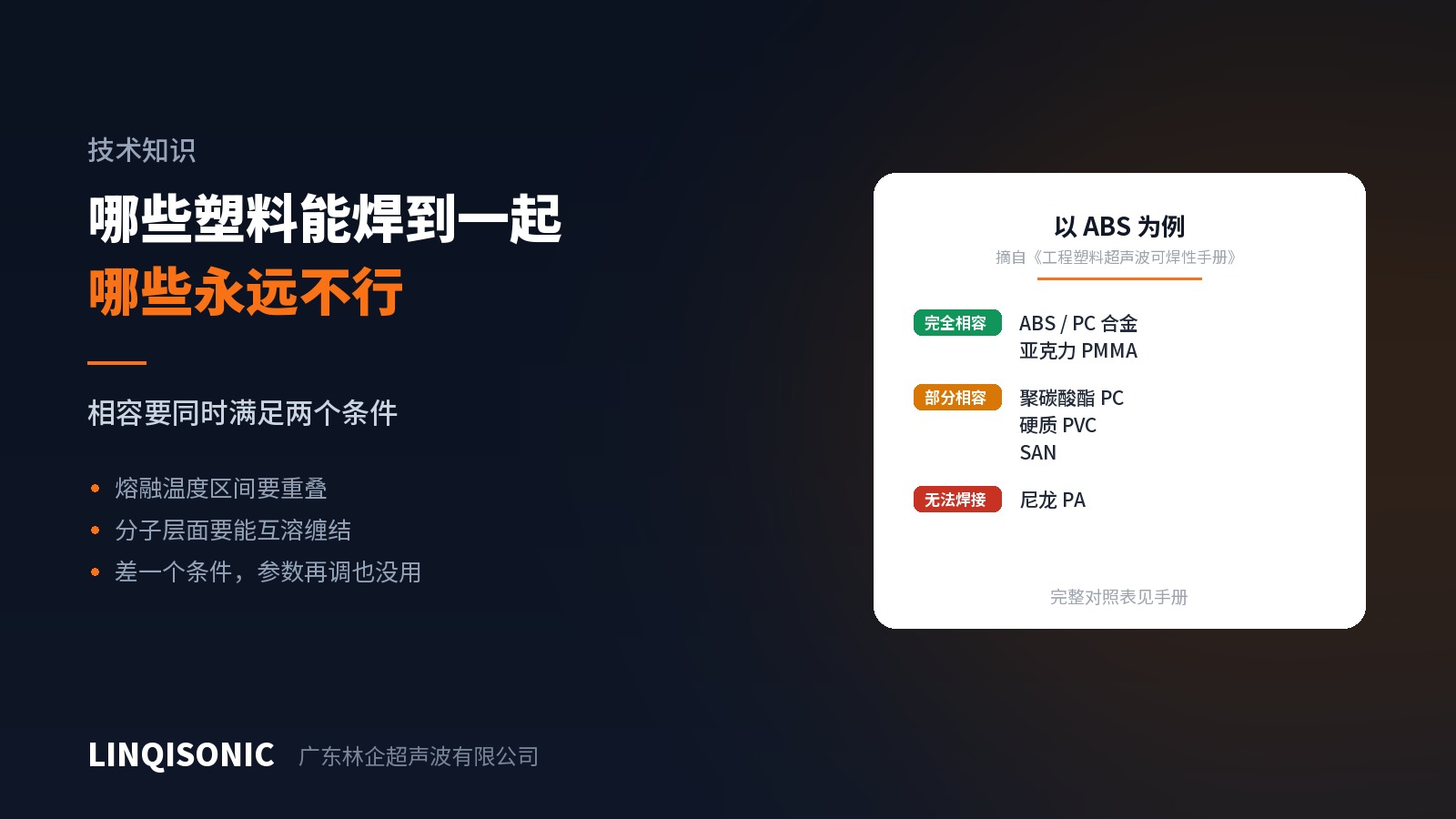
"My two parts are different materials — can they be welded together?" This is among the most frequent questions we receive.
The answer is not a simple yes or no, but the rule for deciding is clear: two dissimilar plastics can only be welded if both of two conditions are met. One is not enough.
The two conditions
One: the melt temperature ranges must overlap.
Ultrasonic welding requires both sides of the interface to be flowable at the same moment. If material A is already flowing while B is still solid, or B melts only after A has begun to degrade, there is no shared window. The wider the gap, the narrower that window, until it disappears.
Two: the polymers must be miscible at the molecular level.
This one is more fundamental and more often overlooked. Two melts touching is not a weld. The molecular chains on each side have to diffuse across and entangle with each other so that a continuous structure forms on cooling. If the two polymers are chemically immiscible, then even when both are molten the interface is merely in contact — and once cool it separates under load with a fracture surface so clean it looks unwelded.
That second condition explains a common puzzle: why some materials with similar processing temperatures still refuse to bond.
Amorphous versus semi-crystalline: the hardest line
Engineering thermoplastics fall into two families by molecular arrangement, and that line largely governs whether cross-family welding is possible at all.
Amorphous — ABS, PC, acrylic, PS, SAN, rigid PVC, PPO-based resins. Chains are disordered, and on heating there is a broad softening range with a gradual transition from soft to flowing. That breadth gives the process considerable tolerance.
Semi-crystalline — nylon, POM, PP, PE, PET, PBT, PPS, PEEK. Chains are locally ordered, with a defined melting point, a narrow melting range, and a rapid transition to flow.
Dissimilar welding across those two families is, in the great majority of cases, not achievable: melting behaviour differs too much for the windows to align, and the molecular structures are usually incompatible as well.
Why nylon will not weld to ABS
This is the textbook case, and the pairing we are asked about most.
Nylon is semi-crystalline, carries amide groups, is strongly polar and forms extensive hydrogen bonding between chains. ABS is a styrenic amorphous resin and essentially non-polar. The two are immiscible in the melt — like oil and water. Heat both until they flow and they still will not diffuse into one another; no entanglement forms across the interface.
Add the difference in melting behaviour: ABS softens progressively over a wide range, while nylon stays solid until it suddenly flows at its melting point. Finding a moment that suits both is difficult in itself.
So this is not a case of parameters not yet dialled in. The combination does not work in principle. More power, longer weld time, a different horn — none of it helps; it only scorches the ABS side.
Faced with this pairing, change the joining method: mechanical fastening (screws, snap fits, ultrasonically inserted metal inserts) or adhesive bonding. Time spent on parameters is wasted.
What ABS does weld to: a worked example
Looked at from the other side, ABS is one of the most accommodating materials there is.
Fully compatible — ABS/PC alloy and acrylic (PMMA). All amorphous, with well-overlapped softening ranges and molecular miscibility. ABS to acrylic is a common pairing in products needing a transparent window.
Partially compatible — polycarbonate (PC), rigid PVC and SAN. These will weld, but the window is narrower than for fully compatible pairs and the strength does not reach that of like-to-like welding. Take ABS to PC: both amorphous and to a degree miscible, but PC softens at a distinctly higher temperature, so only part of the two windows overlaps. It can be done, but with little parameter margin and a higher demand on consistency.
What "partially compatible" means in practice: usable, but not where the joint carries structural load or must be hermetic — and re-validate after any change of material batch.
What about nylon to nylon
Like-to-like nylon welding is entirely possible, though nylon is not among the easier semi-crystalline materials: a narrow melting range, a small energy window, and strength that is sensitive to parameter drift.
Where joints come out weak or unfused, work through these in order.
1. Change to a shear joint. An energy director depends on instantaneous melting at a tip followed by flow, which is hard to reproduce consistently on a narrow-melting material. A shear joint generates heat through sustained friction along an interference fit, giving a more controllable melt, and is generally the better choice for semi-crystalline resins.
2. Increase amplitude. Semi-crystalline materials absorb extra heat to break down crystalline order and need a higher energy density than amorphous ones. Where amplitude is short, extending the weld time achieves nothing — heat spreads into the surrounding material and the interface still does not melt.
3. Make the fixture rigid. A narrow window means repeatability matters. Any movement of the part in the fixture changes the energy path from piece to piece and the result drifts. This shows up far more sharply on nylon than on ABS.
Where the full reference sits
ABS above serves to explain the principle, but the possible material combinations run well beyond these few pairs. The Weldability of Engineering Plastics handbook contains the full compatibility reference for common engineering thermoplastics — which combinations are fully compatible, which are partial, and which will not join under any conditions — along with difficulty ratings for each material across near-field welding, far-field welding, staking, insertion and spot welding.
It is available from the downloads page.
Equipment selection only becomes meaningful once weldability is established. Models and operating frequencies are on the ultrasonic welding machine pages.
If you have a specific material pairing to assess, send us both grade designations, or ask through the online technical consultant on the website. Drawings can go to 1427498429@qq.com, or call +86 769 8202 9510 / +86 137 6001 0932.