
Choosing the Trigger: Deciding When the Weld Starts Counting
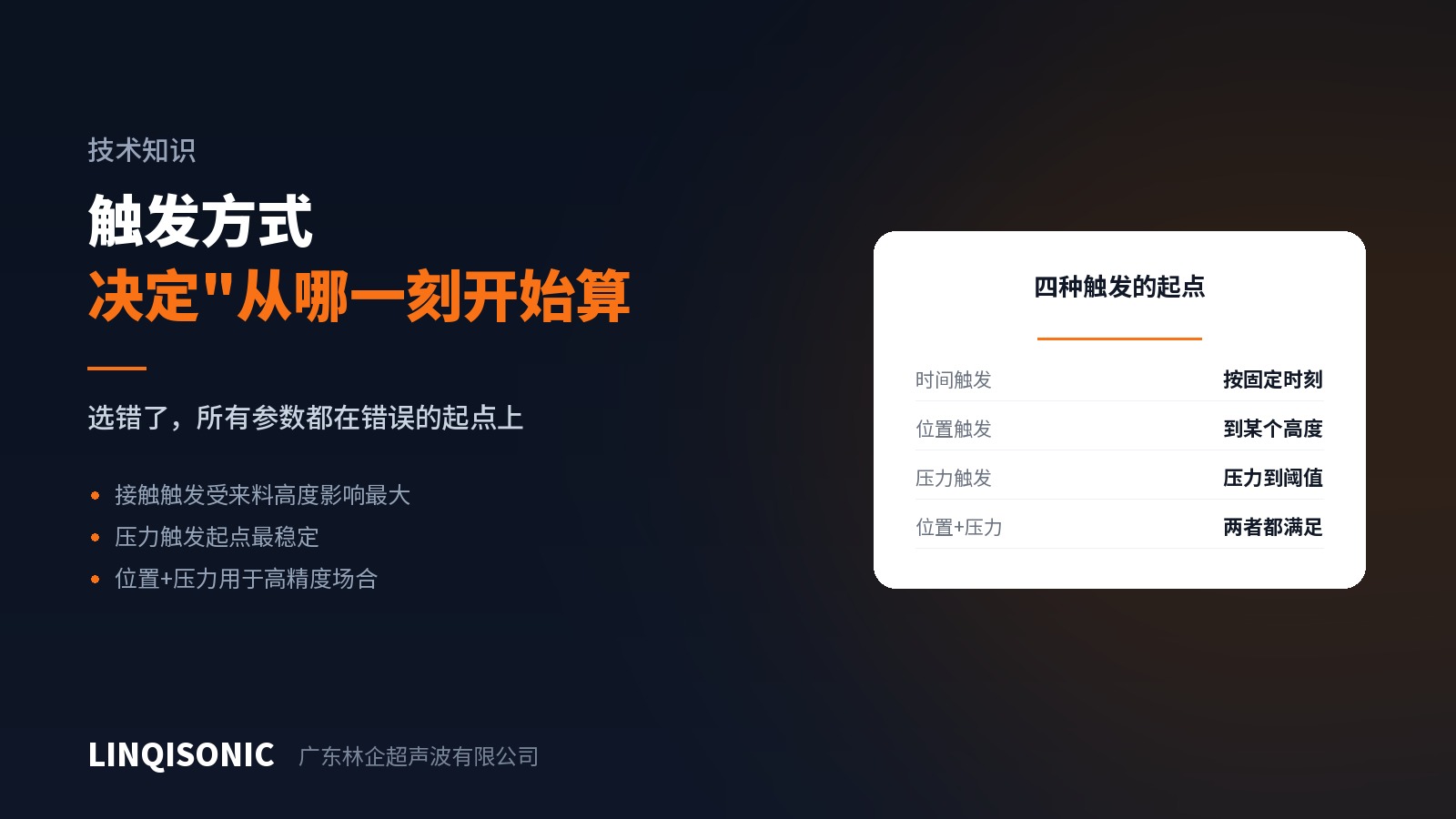
When setting a machine, attention goes to amplitude, time and force; the trigger is rarely considered. Yet the trigger determines the moment ultrasound begins — and a wrong start point puts every subsequent parameter on a drifting datum.
Four triggers
Time trigger — ultrasound starts a fixed interval after downward travel begins. Simplest, but it takes no account of whether the horn has actually reached the part. With height tolerance or fixture clearance, the real contact moment differs from part to part.
Position trigger — starts when the horn reaches a set position, referenced to the machine origin, so incoming height tolerance translates directly into differences in contact force.
Force trigger — starts once the horn contacts the part and reaches a set force. The most stable option: whatever the part height, ultrasound always begins from the same established-force condition.
Position plus force — both conditions must be met. Used where start-point consistency is critical, and it also guards against a missing or misplaced part.
Why the start point matters
The first instant of an ultrasonic weld decides a great deal. Contact area is at its smallest and energy density at its highest, and whether melting initiates cleanly is settled there.
If ultrasound begins before the horn has properly seated, the first portion of energy goes into pressing the parts together rather than melting the interface. For the same energy setting, the fraction actually used for welding then differs part to part.
Conversely, if ultrasound starts too late the horn has already deformed the part, and the starting condition is inconsistent for the opposite reason.
When force trigger becomes necessary
Wide incoming height tolerance. Moulded part height varies more than expected, particularly on large or thin-walled parts. Force trigger references each part's actual contact state and absorbs that variation.
Soft materials. PP, PE and TPU compress after contact, and a position trigger struggles to define where contact begins.
Thin walls. Slightly excessive contact force deforms the part, so the start point must be precise.
Cosmetic parts. Impact at the moment of contact is a principal source of marking; force trigger with a slower approach improves it noticeably.
An easily missed companion setting
The approach speed before the trigger deserves equal attention. Fast approach means a harder impact, heavier marking and a less stable start; slow approach costs cycle time. The sensible arrangement is rapid approach with deceleration before contact, which many machines support as a staged speed profile.
Trigger options and speed control by machine are on the ultrasonic welding machine pages. Send part drawings and incoming tolerances to 1427498429@qq.com, or call +86 769 8202 9510 / +86 137 6001 0932.