
Cold Welds: It Looks Joined, but Nothing Fused
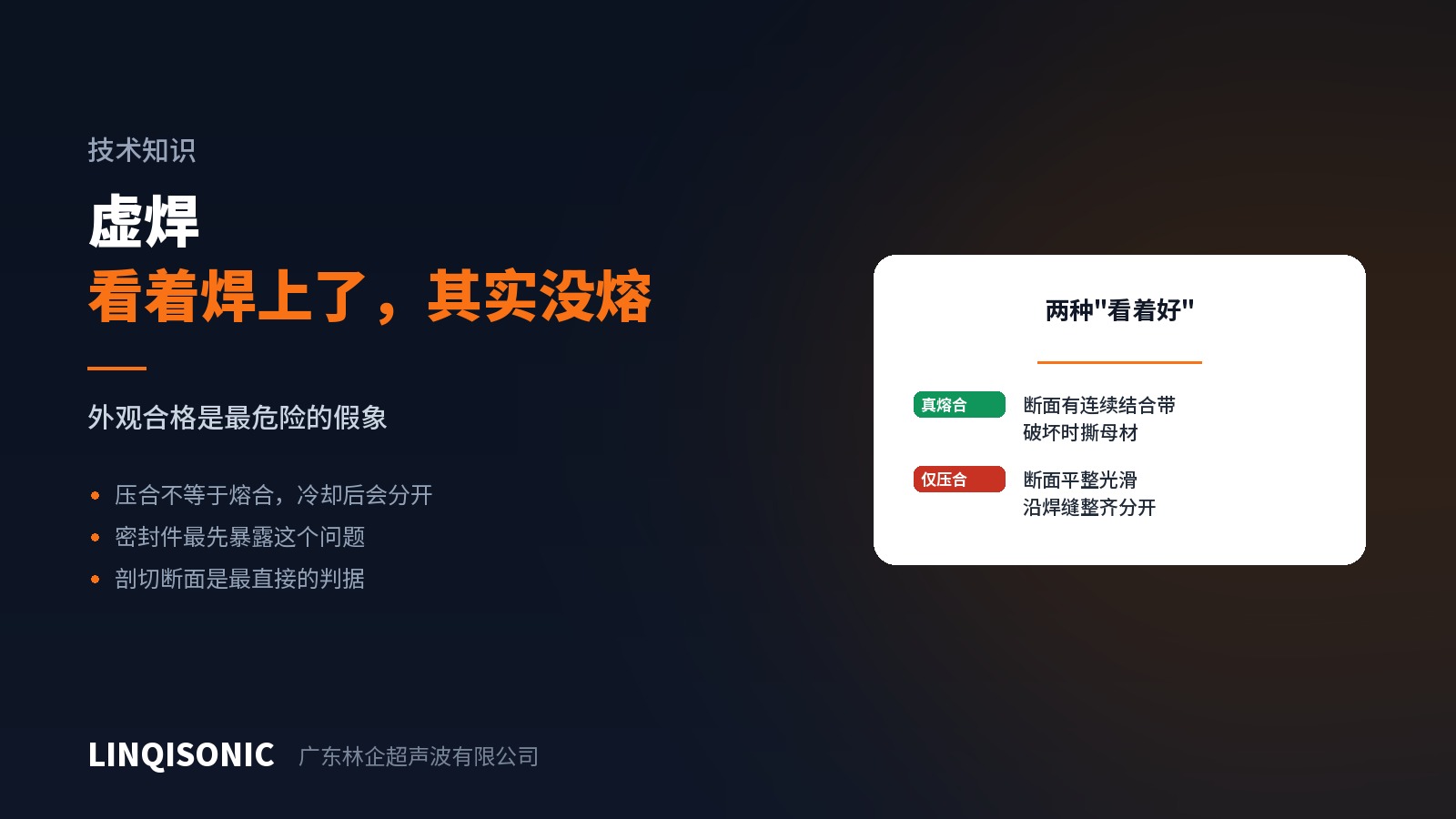
The most troublesome weld defects are not the visible ones. They are the invisible ones.
A cold weld looks perfect, holds its dimensions, and may even survive a casual pull by hand. But no molecular bond formed at the interface — the two faces are simply pressed together.
How it happens
Ultrasonic welding requires the interface to reach melting so that chains on each side interdiffuse and entangle into a continuous structure. Break any link in that chain and the result is mere contact:
Insufficient energy — the interface softens but never melts; the softened material conforms under force and looks perfectly closed while nothing fused.
Energy never reaches the interface — excessive far-field attenuation, inadequate part stiffness, or a fixture that fails to support, and the energy dissipates on the way.
Faces not parallel — one side fuses while the other is merely pressed. Broken open, half the face shows fusion marks and half is smooth.
Incompatible materials — where dissimilar resins are immiscible, no amount of welding produces more than contact.
How to detect it
Section and inspect. The most direct and reliable method. A genuinely fused joint shows a continuous bond band and tears the parent material on failure, leaving a rough surface. A cold weld separates cleanly along the joint with a smooth face.
Leak test. Cold welds show up first on sealed parts; a pressed interface almost always leaks.
Watch the scatter in strength. Cold-welded parts give widely dispersed failure loads — some acceptable, some very low. The mean may still look adequate while the standard deviation grows. An earlier signal than the average.
Thermal cycling or ageing. A pressed interface separates as the two sides contract differently. Cold welds do not survive thermal cycling.
How to avoid it
Replace after-the-fact sampling with process monitoring. The most effective measure. Genuine fusion and mere contact look different on the weld curve — power changes characteristically once melting begins, and post-weld depth differs. Set limits on energy, power and post-weld depth together and a cold weld is caught at the moment it is made.
Do not rely on one dimension. Monitoring only post-weld depth, a crushed part and a fused part can give the same height; monitoring only energy, energy going astray can read much like energy arriving. Cross-checking dimensions is what makes it reliable.
Keep periodic destructive sampling. However good the monitoring, sectioning samples to confirm fusion remains necessary — especially after a change of material, tooling or shift.
One caution
Cold welds are most often introduced while chasing the best appearance during set-up — reducing energy step by step to eliminate flash and marking, arriving at the point where nothing shows, which frequently lies below the fusion threshold.
Appearance and fusion are separate criteria and must be confirmed separately.
Multi-dimensional monitoring by machine is described on the ultrasonic welding machine pages. Send section photographs and process data to 1427498429@qq.com, or call +86 769 8202 9510 / +86 137 6001 0932.