
Fixture Material: Steel, Aluminium or Polyurethane
Nest and fixture materials are often chosen by shop habit — steel because steel has always been used. The choice affects the weld result more than that suggests.
Three requirements that pull against each other
Support. The fixture must take the weld force without deflecting. How far the part sinks during welding sets the real pressure at the interface.
No marking. The contact face leaves an impression on the back of the part, which matters on cosmetic work.
No energy absorption. A nest that absorbs vibration leaves less energy at the interface, and soft materials lose here by nature.
The three common materials
Steel. The best stiffness, wear resistant and dimensionally stable, suited to high force and sustained high output. It is hard, marks parts readily and is unkind to soft materials and thin walls. Anvils for metal welding are essentially always steel, because there the requirement is to grip the work firmly.
Aluminium. Easy to machine, cheap, light and quick to modify, suited to samples and medium volumes. Less stiff than steel, it wears and distorts over time, and marks somewhat less.
Polyurethane and engineering plastics. Soft contact that barely marks, suited to cosmetic parts and soft materials. It absorbs vibration, has low stiffness and takes a permanent set under sustained load, so it needs periodic replacement. It is usually not a whole nest but a contoured layer on a steel or aluminium base.
Common combinations
The most used arrangement is a rigid base with local soft facing: steel or aluminium for stiffness and dimensional stability, with a polyurethane layer or a local relief on the faces that touch the part, balancing support against appearance.
Another is zoning: rigid material where the load is carried, soft contact where the surface is visible, arranged separately in the same fixture.
Practical judgements
The part sinks noticeably during welding — fixture stiffness is short. Change the base material or thicken it before touching parameters.
The back of the part is marked — first see whether the contact area can be enlarged, then consider a soft facing. Soft facing has a cost: it absorbs energy.
Thin walls and soft materials — the nest should follow the contour and support by shape rather than pressing on a few points. Here the fit of the profile matters more than the material.
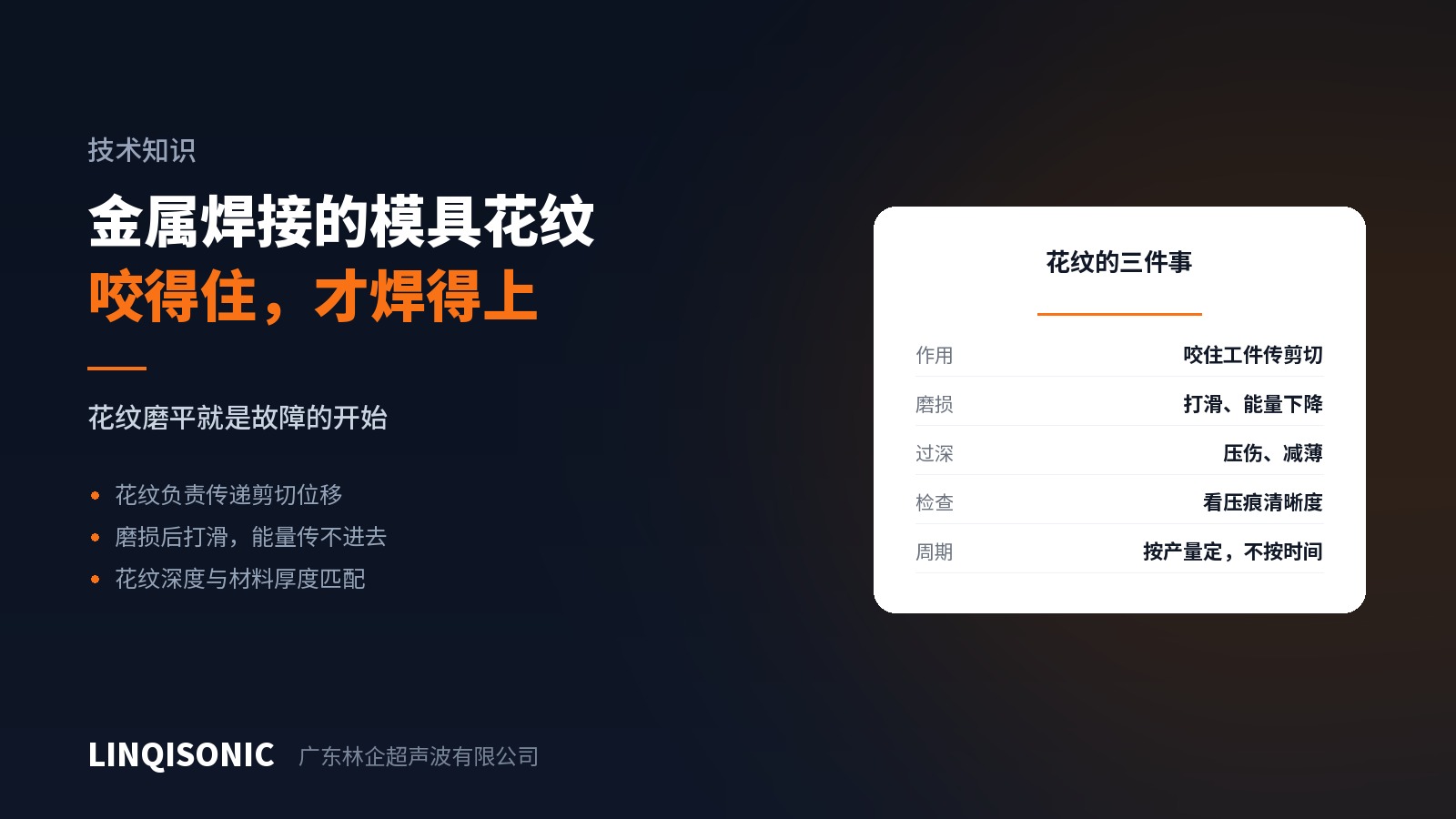
Anvils for metal welding exist to grip the work and transmit shear. Use knurled steel and replace it once the pattern flattens; it is a consumable.
One thing easily missed
The fixture itself can resonate. A large thin fixture plate resonating near the ultrasonic frequency absorbs energy and emits a piercing noise. Give the fixture enough mass and stiffness, adding ribs or fixing points where necessary.
Fixture options, support area, stroke and force ranges by model are on the ultrasonic welding machine pages. The joint and tooling design-review checklist is on the downloads page.
Send part drawings and appearance requirements to 1427498429@qq.com, or call +86 769 8202 9510 / +86 137 6001 0932.