
AI Technical Consultant Now Online for Machine Selection
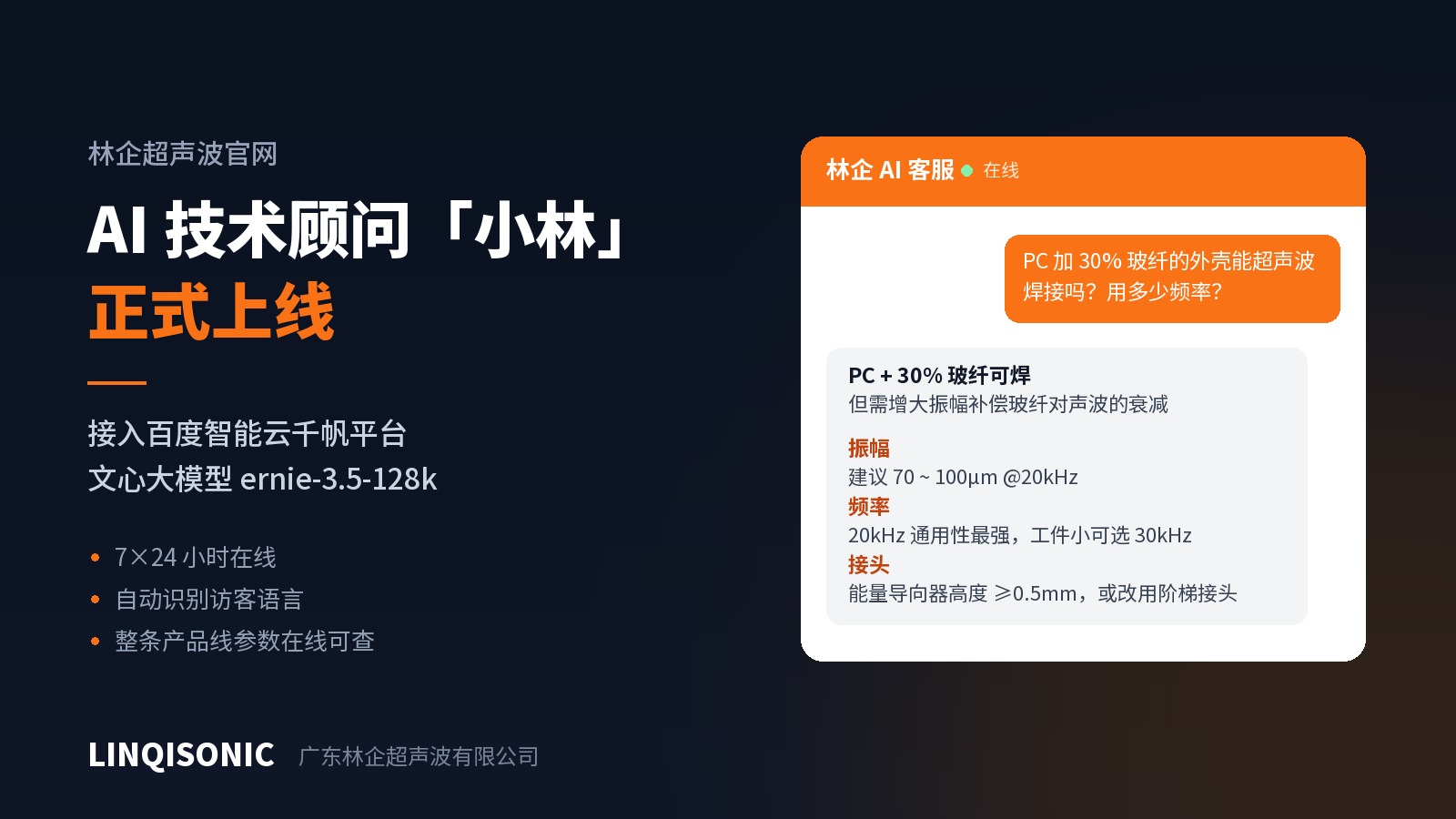
Dongguan, Guangdong — September 9, 2026 — Guangdong Linqi Ultrasonic Co., Ltd. (LINQISONIC) today announced the launch of an AI technical consultant on its corporate website, www.qicsb.com. Built on Baidu AI Cloud's Qianfan platform using the ERNIE 3.5 128K model, the system answers questions on material weldability, equipment selection and process parameters for visitors worldwide, independent of office hours or time zones.
Questions come before quotations
In ultrasonic welding equipment procurement, the first hurdle is rarely price. It is feasibility. A customer holding a part needs to establish whether the material can be welded at all, what power is required, which operating frequency applies, and whether the joint geometry has to change. These questions cannot be answered without engineering judgement — and the engineers who have it are not usually sitting at the other end of a website.
The company's published business hours are 08:00–12:00 and 14:00–18:00 China Standard Time. For domestic customers, questions tend to arise after work. For customers in Europe and the Americas, the working days barely overlap at all. Until now such enquiries could only be handled by leaving a message and waiting for a reply, a round trip usually measured in days.
"What we receive most is not requests for quotation, it is questions," a company representative said. "A customer brings us a glass-filled PC housing and asks whether it can be welded, whether the energy director needs redesigning. An engineer can answer that in three sentences. But the customer is usually browsing our site in the evening or at the weekend, when nobody is there."
The system is not intended to replace sales staff. It absorbs the baseline questions engineers would otherwise answer repeatedly, leaving cases that require on-site judgement and design work to people.
Why a long-context model
The choice of ERNIE 3.5 128K was driven primarily by context length.
Technical enquiries in ultrasonic welding are tightly coupled: resin grade, filler content, joint design, operating frequency, amplitude range and tooling dimensions all constrain one another, and changing one typically moves several others. A single conversation may need to hold more than a dozen constraints at once. With a smaller context window, the underlying knowledge has to be trimmed repeatedly, which invites contradictions once the customer starts asking follow-up questions. A 128K window allows the full product-line specification to be loaded in one pass.
Responses are streamed token by token, so visitors are not left waiting for a complete answer to render. The model detects the visitor's language and replies in kind, consistent with the 28 languages the website already supports; product designations remain untranslated in every language.
The knowledge base — and knowing when to say "I don't know"
Complete specifications for the current product line were written into the system prompt, covering the Dream S servo-driven ultrasonic plastic welder, the Dream Q pneumatic ultrasonic plastic welder and the ideal 6 intelligent ultrasonic generator: drive type, power ratings, available frequencies, welding modes, trigger methods, stroke and load capacity, maximum tooling size, and the applications each is suited to.
One design decision runs in the opposite direction to the usual objective.
Large language models tend to produce an answer whether or not they have one, and are particularly prone to inventing specifics such as addresses and telephone numbers. The company encountered exactly this during deployment: the system generated a landline number that did not exist, together with incorrect business hours.
For a manufacturer, the cost of that error is not embarrassment. It is a customer dialling a number that does not connect.
A hard constraint was therefore written into the system prompt. Telephone numbers, email addresses, the company address and business hours must be reproduced verbatim from confirmed company records. Anything not confirmed — fax numbers, messaging IDs, holiday schedules — must be answered with "not certain", and may not be filled in by the model.
"The AI is allowed not to know," the representative said. "It is not allowed to make things up."
A worked example
In pre-launch testing, asked whether a housing in PC with 30% glass fibre could be ultrasonically welded and at what frequency, the system returned an answer on three levels:
- Feasibility — weldable, but amplitude must be increased to compensate for the attenuation caused by the glass fibre; 70–100μm at 20kHz suggested;
- Frequency — 20kHz offers the widest applicability, with 30kHz an option for smaller parts;
- Joint design — energy director height of at least 0.5mm, or a step joint to reduce the influence of the fibre.
Having given that assessment, the system then asked for part dimensions and daily output — the two figures that determine power rating and automation layout, and which must be established before any proposal can be drawn up.
What comes next
The company plans to connect its published technical literature to the conversational system. The downloads section of the website currently offers the Weldability of Engineering Plastics handbook, the Plastic Staking Design Guide, the Amplitude Reference Guide, the Horn Selection & Design Guide and the Energy Director & Joint Design Guide. Once linked, the assistant will be able to point to the relevant section of a specific document so that customers can verify the reasoning for themselves.
Founded in 2020 and headquartered in Zhangmutou, Dongguan, Guangdong Linqi Ultrasonic Co., Ltd. develops, manufactures and supplies ultrasonic welding equipment across three lines: ultrasonic plastic welding, ultrasonic metal welding and ultrasonic cutting.
The AI technical consultant is now live across www.qicsb.com and can be opened from the lower-right corner of any page.