
Why Medical Disposables Are Welded Rather Than Glued
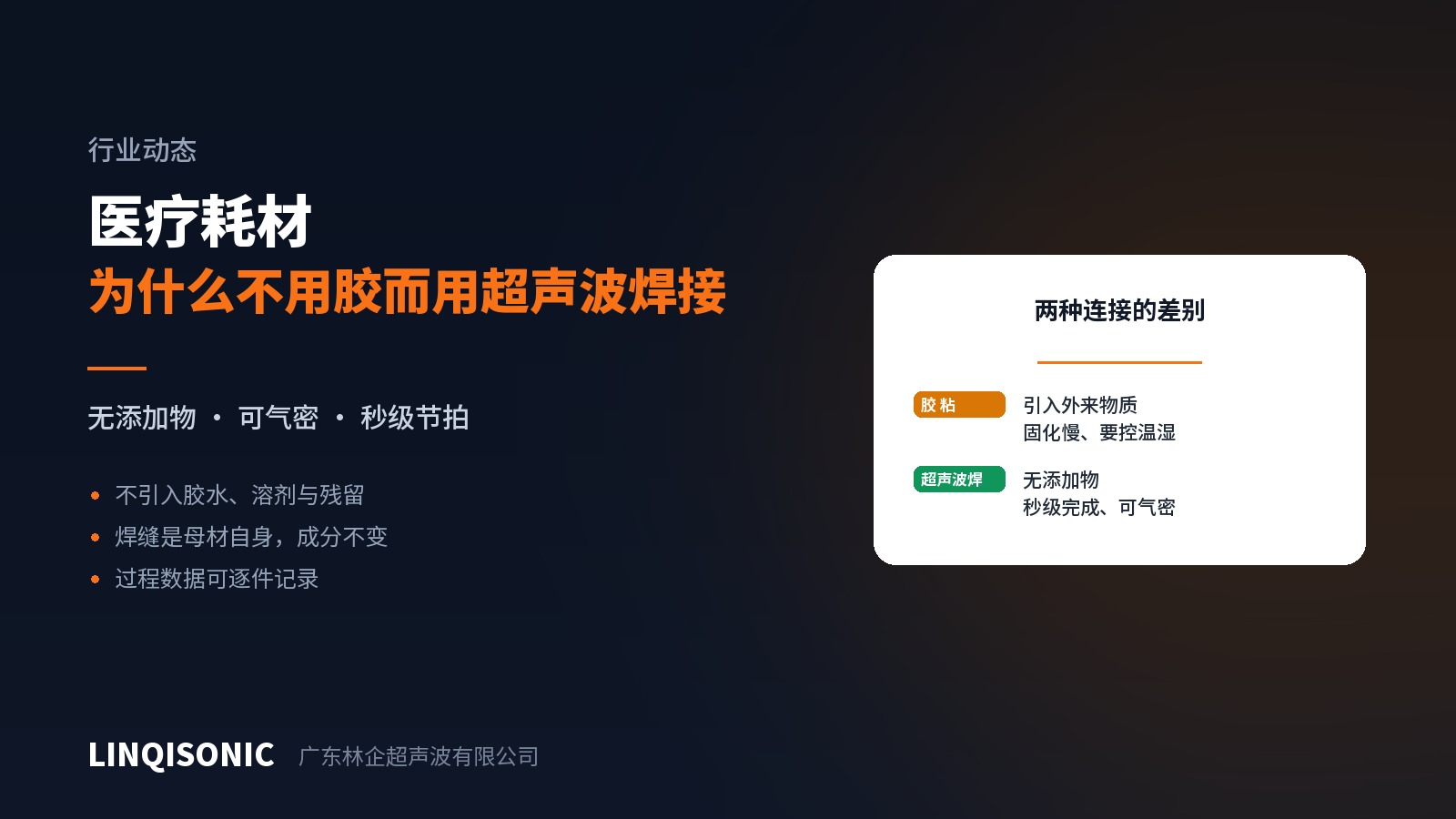
Infusion sets, filters, blood collection devices, masks, diagnostic cassettes — a great many medical disposables are ultrasonically welded rather than glued. Speed is not the only reason.
Adhesive introduces a foreign substance
Using adhesive means adding a material to the product. For a medical device that brings a chain of consequences:
Solvent and unreacted monomer residues must be assessed and controlled;
biocompatibility has to be evaluated for that adhesive specifically;
cure conditions — temperature, humidity, time — must be controlled and recorded, since incomplete cure raises residues;
ageing — adhesive properties change over time and through sterilisation.
Ultrasonic welding introduces nothing. The weld is the parent material, melted and re-solidified, so the product's material declaration gains no additional line because of the joining process. What that saves in registration documentation and change control usually outweighs any difference in production cost.
Other practical advantages
Cycle time. Welding completes in seconds; adhesive requires cure time, buffer space and work in progress. Across high-volume disposables this shows up directly in throughput and inventory.
Hermeticity. Infusion and filtration products carry hard sealing requirements. With appropriate joint design an ultrasonic weld can be hermetic, and the seal band is continuous parent material with no adhesive debond failure mode.
Cleanliness. No adhesive vapour, no solvent, no extraction requirement; equipment can also be configured to suit cleanroom requirements.
Traceability. Energy, power, force and pre/post-weld height can carry monitoring limits and be recorded for every part — a real capability where batch or unit-level records are required.
Points to watch on medical parts
Material changes need re-validation. Medical parts commonly use PP, PC, ABS and PETG. Changing supplier or batch for the same grade can shift the process window. Such changes already go through change control in this industry; weld parameter re-validation belongs in that process.
Sterilisation affects the material. Irradiation embrittles some resins; ethylene oxide raises residue questions. Weld performance after sterilisation should be part of validation, not only performance immediately after welding.
Particulates. Welding can generate a small quantity of particles. Joint design should direct melt flash inward or outward in a controlled way so it cannot enter the fluid path — a design-stage decision.
Appearance on clear parts. Transparent PC and PETG readily show whitening or haze near the weld. This depends on joint form, energy and clamping, and needs to be confirmed by trial.
Weldability assessment, joint selection and energy director dimensioning are covered in the handbooks on the downloads page. Equipment is on the ultrasonic welding machine pages.
Send resin grade, part drawings and sealing requirements to 1427498429@qq.com, or call +86 769 8202 9510 / +86 137 6001 0932.